Introduction
Organizations are drowning in data they can't use. Spreadsheets crash. Legacy databases choke on volume. Reports take weeks to build and arrive too late to matter.
Meanwhile, the scale keeps growing. IDC's Global Datasphere measured 45 zettabytes of data created worldwide in 2019 and forecast that figure would climb to 175 zettabytes by 2025. Most of that data sits untouched in silos, never reaching the people who need it to make decisions.
The cost of inaction isn't neutral. Companies that can't operationalize their data miss patterns, react slower, and lose ground to competitors who already have.
This guide breaks down what big data analytics solutions actually are, the technologies behind them, where they deliver the most value, and how to choose an implementation partner that won't slow you down.
Key Takeaways
- Big data analytics solutions turn massive datasets into actionable business decisions
- Core technologies span four categories: storage, processing, analytics/AI, and visualization/governance
- Cloud platforms and real-time streaming now let organizations act on data in minutes, not months
- Success depends more on clear objectives and data quality than on tool selection
- The right consulting partner can shorten time-to-value and reduce costly missteps
What Are Big Data Analytics Solutions?
Big data refers to the datasets themselves: information too large, fast-moving, or varied for spreadsheets and traditional databases to handle. A big data solution is different. It's the combination of technologies, platforms, and processes organizations build to extract value from that data.
Big data is the raw material; a big data analytics solution is the refinery that turns it into something usable.
IBM defines big data analytics as the pairing of distributed storage and processing with analytics, machine learning, and visualization tools designed to work at scale. Without that combination, data just accumulates. With it, data becomes a decision engine.
The Five Characteristics That Define Big Data Complexity
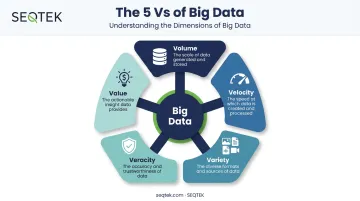
Every effective solution has to address five characteristics, often called the "5 Vs":
- Volume – the sheer scale, from terabytes to hundreds of petabytes
- Velocity – how fast data arrives and needs to be acted on
- Variety – the mix of structured, semi-structured, and unstructured formats
- Veracity – whether the data is accurate, complete, and trustworthy
- Value – the actual business benefit gained once it's analyzed
A solution that handles volume but ignores veracity will just produce fast, confident, wrong answers. All five have to be addressed together.
In practice, a working solution moves through three stages: integrating data from disparate sources, storing and managing it at scale, and analyzing it to surface insight. Skip any one of those stages, and you end up with a data lake full of information nobody uses. That's a common outcome, and it's an expensive one.
Types of Big Data Analytics Technologies
Big data technologies generally fall into four categories: storage, processing, analytics/AI, and visualization/governance. Each plays a distinct role, and most modern solutions combine all four.
Storage Technologies
Not all data belongs in the same type of storage:
- Data lakes hold raw, mixed-format data (structured, semi-structured, unstructured) and apply structure only when the data is read
- Data warehouses store cleaned, processed data with a schema defined before loading, built for SQL queries and BI reporting
- NoSQL databases support flexible, nonrelational models like documents, key-value pairs, and graphs, scaling horizontally as demand grows
Use a lake when you're not yet sure how the data will be used. Use a warehouse once you know exactly what questions you're asking.
Processing Technologies
Processing frameworks split into two philosophies. Hadoop MapReduce distributes large jobs across clusters, processing multi-terabyte datasets in batches. It's cost-efficient but not fast.
Apache Spark and Apache Kafka solve for speed instead. Spark's Structured Streaming processes live data incrementally, while Kafka publishes and stores event streams so they can be acted on in real time.
The tradeoff is straightforward: batch processing costs less and handles historical volume well. Streaming costs more but enables same-moment decisions, like flagging a fraudulent transaction before it clears.
Analytics and AI Technologies
This is where raw processing turns into foresight. Machine learning platforms such as TensorFlow and AWS SageMaker, paired with predictive analytics and data mining techniques, take historical and real-time data and convert it into:
- Forecasts of demand, failure, or churn
- Anomaly detection that flags outliers before they become problems
- Automated decisioning that removes manual review from routine cases
Visualization and Governance Tools
Dashboards and BI tools (Power BI is a common example) translate analysis into something a decision-maker can act on in seconds. Governance tools work in parallel, maintaining compliance, security, and access control as the data footprint scales. Without governance, growth just multiplies risk.
Choosing the right combination of these technologies depends on existing infrastructure, data maturity, and business goals. SEQTEK's data architects help clients navigate these decisions before committing to a platform.
Key Benefits and Industry Applications
Faster decisions are the headline benefit, but the numbers behind them are worth understanding. McKinsey research on data-driven B2B growth found that companies using data-driven sales engines report above-market growth and EBITDA increases of 15% to 25%. That's a structural advantage over competitors still relying on gut instinct.
Operational efficiency tells a similar story. Predictive maintenance programs typically cut machine downtime by 30% to 50% and extend equipment life by 20% to 40%, according to McKinsey's manufacturing analytics research. Fewer surprise breakdowns mean fewer emergency repair bills and less unplanned downtime across the plant floor.
Industry relevance varies, but the pattern holds across sectors:
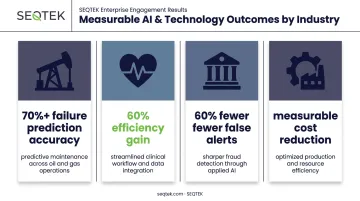
- Oil & gas – predictive maintenance models have flagged gas-compressor failures with over 70% accuracy, giving crews days of lead time
- Healthcare – analytics platforms process patient data under HIPAA safeguards; one health plan reported a 60% efficiency gain after deploying NLP-based analysis of clinical records
- Banking – HSBC's fraud-detection system screens over 1 billion transactions monthly, cutting false alerts by 60% while catching 2-4 times more true fraud cases
- Manufacturing – equipment uptime and process optimization drive measurable cost reduction across production lines
Beyond efficiency and industry-specific gains, personalization is the quieter benefit. Combining structured transaction data with unstructured behavioral data, like browsing history or support tickets, lets organizations tailor offers and service in ways a spreadsheet never could.
Best Practices for Implementing Big Data Analytics Solutions
Most failed analytics projects don't fail because of bad technology. They fail because of bad sequencing.
Start with objectives, not tools. Define the specific business question you're trying to answer before evaluating platforms. "We want to reduce equipment downtime by 20%" is a use case. "We should adopt a data lake" is not.
Fix data quality early. Objectives are only useful if the underlying data can support them. Analytics built on inconsistent, siloed, or duplicate data produces unreliable insight, regardless of how sophisticated the model is. Governance, ownership, and access controls need to be established before scaling, not after.
Address the talent gap directly. Clean data and clear objectives still require the right people to translate them into decisions, and this is the barrier organizations run into most often. McKinsey surveyed enterprises and found that 77% reported lacking the data talent and skills their transformation required. Organizations typically respond in one of three ways:
- Train existing staff – slower, but builds internal capability over time
- Hire specialists – faster, but competitive and expensive in a tight talent market
- Engage a consulting partner – fastest path to execution, with knowledge transfer built in
None of these paths is universally right. The best choice depends on timeline, budget, and how much internal capability you need to retain long-term.
Choosing the Right Big Data Analytics Partner
Building big data capabilities entirely in-house sounds appealing until you factor in the recruiting timeline, the training curve, and the risk of getting architecture decisions wrong the first time. That's why many organizations bring in an experienced partner instead: faster execution, access to specialized talent, and lower decision-making risk on choices that are expensive to reverse.
SEQTEK approaches this through a Localshoring model. Rather than routing work through offshore teams across time zones, SEQTEK embeds local architects, engineers, and analysts directly with client teams. That proximity eliminates the communication lag and cultural friction that slow down offshore engagements, and it keeps knowledge transfer flowing both directions instead of staying locked inside a vendor.
The model matters most in the moments that decide whether a project succeeds:
- Faster iteration – shorter feedback cycles because teams work in the same hours, often the same rooms
- Real knowledge transfer – internal staff build capability alongside the engagement instead of losing it when the contract ends
- Clearer governance – shared documentation and tools reduce the oversight burden on your team

This approach shows up in SEQTEK's track record. Since 1999, the Oklahoma-based team has delivered data architecture, machine learning, and predictive analytics engagements across oil & gas, banking, healthcare, and manufacturing, with clients including GE, ABB, and ONEOK.
That history reflects an outcome-based approach: SEQTEK measures success through lasting partnerships and measurable results delivered to every client.
Frequently Asked Questions
What is a big data solution?
A big data solution is the combined set of technologies and processes organizations use to store, process, and analyze large, complex datasets that traditional tools can't handle. It includes storage, processing, analytics, and visualization working together.
What are the 4 types of big data technologies?
Storage (data lakes, warehouses, NoSQL databases), processing (batch and streaming frameworks), analytics/AI (predictive models and machine learning), and visualization/governance (dashboards, BI tools, and compliance controls).
What is the difference between big data and big data analytics?
Big data refers to the massive, complex datasets themselves. Big data analytics is the process and toolset used to extract insights, patterns, and decisions from that data.
Which industries benefit most from big data analytics solutions?
Healthcare (patient data and compliance), finance (fraud detection), oil & gas (predictive maintenance), retail (personalization), and manufacturing (equipment uptime) see some of the clearest returns.
How much does it cost to implement a big data analytics solution?
Costs vary widely based on data volume, infrastructure choice (cloud vs. on-premises), and project scope. A phased approach, starting with a pilot before scaling, helps control investment and reduce risk.
Can I outsource big data analytics instead of building an in-house team?
Yes. Many organizations partner with consulting firms or use localshoring (in-country outsourcing) models to access specialized talent, such as architects, engineers, and analysts, without the overhead of a full in-house build.