Introduction
Enterprise appetite for generative AI has never been higher heading into 2026. Budgets are approved. Executives are asking hard questions. Yet most projects still stall.
Gartner reported that at least 50% of generative AI projects were abandoned after proof of concept by the end of 2025, citing unclear business value, unready data, and governance treated as an afterthought. That signals a readiness gap, not a technology failure.
Most organizations don't have in-house expertise in AI strategy, data architecture, and governance to move past experimentation. Running a pilot is easy; scaling one requires expertise most teams haven't built yet.
This guide breaks down what generative AI consulting actually includes, why the stakes are higher in 2026, and how to choose a partner who can get you from proof of concept to production.
Key Takeaways
- Half of GenAI pilots never reach production due to unclear value, weak data, or poor governance.
- GenAI consulting spans strategy, data readiness, implementation, compliance, and adoption.
- Agentic AI is raising the complexity and risk of poor planning heading into 2026.
- The right partner brings unbiased strategy, proximity, and hands-on change management.
What Is Generative AI Consulting?
Generative AI consulting is advisory and hands-on implementation support that helps organizations move from idea to working system. It covers identifying the right use cases, evaluating models and platforms, designing secure architecture, building the solution, and governing it for risk and compliance.
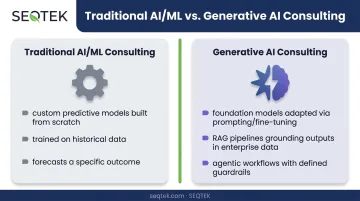
This is a different discipline than traditional AI/ML consulting. Traditional AI/ML work builds custom predictive models from scratch, trained on your historical data to forecast an outcome. Generative AI consulting instead works with:
- Foundation models adapted through prompting, fine-tuning, or retrieval
- Retrieval-augmented generation (RAG) pipelines that ground outputs in your enterprise data
- Agentic workflows where systems take multi-step actions with defined guardrails
Why Expert Guidance Isn't Optional Anymore
BCG surveyed over 1,000 executives across 59 countries and found 74% of companies had not demonstrated tangible AI value, and only 26% had built the capabilities to move beyond proof of concept. BCG's research also found that roughly 70% of transformation effort has to go toward people and process, not algorithms.
That's the gap generative AI consulting exists to close. Deploying a chatbot or licensing a model means little unless it ties back to a measurable business outcome your leadership actually cares about.
Who needs this most? Organizations without dedicated AI talent on staff, complex legacy systems that don't talk to each other, and teams with plenty of pilot energy but no roadmap for scaling past it. These gaps show up often in aviation, energy, banking, and manufacturing organizations pushing AI pilots toward enterprise scale.
Core Services Included in Generative AI Consulting
A real generative AI engagement combines several interconnected services, each one building on the last.
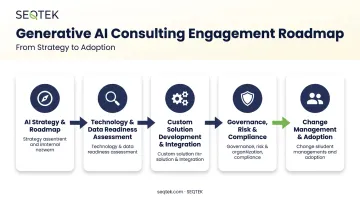
AI Strategy & Roadmap Development
Before any model gets selected, consultants should help you align GenAI initiatives with actual business goals. That means:
- Mapping potential use cases against feasibility and technical complexity
- Prioritizing by revenue or cost impact, not just novelty
- Building a phased roadmap instead of a scattershot list of pilots
This step is where most failed projects go wrong from day one. Skipping it usually means chasing the flashiest use case instead of the most valuable one.
Technology & Data Readiness Assessment
Generative AI can't run on broken foundations. A proper readiness assessment looks at:
- Data architecture: pipelines, data stores, and how information actually flows between systems
- Data quality and governance: cleanliness, lineage, and stewardship
- Cloud and security posture: scalability, performance, and whether infrastructure can support increased AI workloads
- Legacy systems: outdated platforms that block integration
The output should be a gap analysis paired with a prioritized modernization plan that goes well beyond a vague "your data needs work" verdict.
Custom Solution Development & Systems Integration
This is where the actual building happens: selecting the right LLM or model combination, designing RAG pipelines that pull from your proprietary knowledge, and integrating everything into existing ERP, CRM, or operational systems.
The goal is integration that doesn't disrupt how your teams already work. If a new tool requires everyone to change their workflow overnight, adoption will fail regardless of how good the model is.
Governance, Risk & Compliance
Responsible AI frameworks require continuous oversight throughout the engagement. They cover data privacy, model risk, output monitoring, and alignment with industry-specific regulations, whether that's HIPAA in healthcare or financial compliance standards in banking.
Gartner has linked unready data and weak risk controls to failed RAG implementations. Building governance in from the start prevents that outcome.
Change Management & Adoption Support
Successful adoption depends on people as much as technology. Consultants should provide:
- Leadership alignment on goals and priorities
- Team training tied to real workflows
- Structured support that continues well after go-live
SEQTEK treats this as a core differentiator, building leadership alignment and hands-on adoption support into every engagement so tools actually get used.
Why Generative AI Consulting Matters More in 2026
Three forces are converging in 2026 that raise the cost of getting this wrong.
Spending is accelerating fast. Gartner forecast worldwide generative AI spending would reach $644 billion in 2025, a 76.4% jump from the prior year. Budgets are flowing regardless of whether organizations have the readiness to use them well.
Agentic AI is raising the stakes. McKinsey found 62% of organizations were experimenting with AI agents, but only 23% had scaled an agentic system in even one function. Gartner forecasts task-specific agents will appear in 40% of enterprise applications by the end of 2026, up from under 5% in 2025.
Agents that take action, not just generate text, mean governance mistakes carry bigger consequences.
Pilot purgatory is expensive. With roughly half of GenAI projects abandoned after proof of concept, every unfocused pilot burns budget and credibility. Clear scope, honest feasibility scoring, and expert guidance up front are what keep a project out of that graveyard.
High-Impact Use Cases Across Industries
Generative AI's strongest fit is language and knowledge work: retrieval, synthesis, drafting, and conversational support. Here's how that plays out by sector.
| Industry | Common Applications |
|---|---|
| Airlines & oil/gas | Technician copilots for manual retrieval, maintenance documentation, work-order synthesis |
| Banking & financial services | Fraud investigation support, personalized customer service, compliance document review |
| Healthcare | Clinical documentation support, administrative workflow automation, patient communication drafting |
| Manufacturing | Process documentation, quality control support, troubleshooting knowledge assistants |
| Technology | Code generation, internal knowledge management, product development acceleration |
Airlines and oil & gas teams use GenAI so technicians can query manuals and historical work orders conversationally instead of digging through PDFs. In banking and financial services, the same conversational approach drafts compliance reports and helps fraud investigators clear flagged cases faster.
Healthcare and manufacturing organizations lean on GenAI for clinical documentation support and process documentation. Technology companies apply it differently, speeding up code generation and centralizing internal knowledge that used to live in scattered wikis and Slack threads.
One important caveat: equipment-failure prediction and visual defect detection are usually predictive AI or computer vision, not generative AI. A good consulting partner won't blur that line just to sell a bigger project.
How to Choose the Right Generative AI Consulting Partner
Not every consulting firm is built for this work. Here's what to check before signing anything.
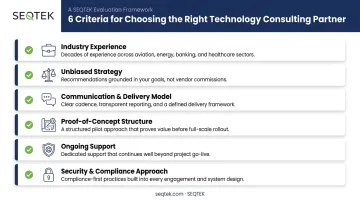
- Industry experience — Ask for case studies or outcomes from organizations similar to yours, not generic AI success stories.
- Unbiased strategy — A partner should recommend the right approach for your data and goals, not push whatever platform they resell.
- Communication and delivery model — Proximity and responsiveness directly affect how fast issues get resolved and decisions get made.
- Proof-of-concept structure — Ask exactly how they scope a POC to validate value before you commit to full-scale investment.
- Ongoing support — Confirm they stick around for adoption, not just the initial deployment.
- Security and compliance approach — Review how they handle governance frameworks relevant to your industry, whether that's financial regulation or healthcare privacy law.
If a firm can't answer these six questions clearly, it isn't ready to guide you through 2026's AI complexity.
Why Organizations Choose SEQTEK for Generative AI Consulting
SEQTEK has worked with organizations across aviation, oil & gas, banking, healthcare, and manufacturing since 1999, delivering more than 500 projects across 25-plus years of combined team experience. That track record includes clients like General Electric, ABB, and ONEOK, organizations that know what legacy complexity actually looks like.
What sets SEQTEK apart is its Localshoring model. Instead of offshore teams working across time zones and cultural gaps, SEQTEK combines local talent with faster turnaround, clearer documentation, and tighter alignment with your internal teams.
That proximity matters most during generative AI work, where feedback cycles need to be fast and context needs to stay intact.
SEQTEK also operates as a trusted partner invested in your long-term outcomes. That shows up in:
- Provides unbiased technology assessments instead of pushing a preferred platform
- Facilitates leadership alignment work that keeps stakeholders on the same page
- Delivers hands-on change management that drives real adoption across teams
If you're evaluating what a generative AI roadmap could look like for your organization, SEQTEK's team can walk through where you stand today and what a realistic path to production looks like.
Frequently Asked Questions
What is generative AI consulting?
It is advisory and implementation support that helps businesses identify high-value use cases and select the right technology so they can deploy generative AI safely. It covers everything from strategy to governance to hands-on integration.
What does a generative AI consulting engagement typically include?
Most engagements cover strategy development, a technical and data readiness assessment, custom implementation, governance and compliance work, and change management support to drive adoption.
How much does generative AI consulting cost?
Costs vary widely based on scope, from focused proof-of-concept engagements to full enterprise rollouts. Data complexity and integration requirements tend to drive the biggest cost swings, with security compliance adding another layer of complexity.
How long does a generative AI consulting engagement take?
Timelines depend on scope. Roadmap development often takes a few weeks, while full implementation, including integration and adoption support, can run several months.
What industries benefit most from generative AI consulting?
Healthcare, banking, manufacturing, and energy see the biggest value, largely because regulatory complexity and data-heavy processes make expert guidance especially important in those sectors.
How is generative AI consulting different from traditional AI consulting?
Generative AI consulting works with foundation models and agentic workflows, often using techniques like retrieval-augmented generation to ground outputs in company data. Traditional AI/ML consulting builds custom predictive models trained from scratch on historical data.