Introduction
Oil prices swung from under $25 a barrel in April 2020 to over $100 two years later. Rigs run leaner crews than they did a decade ago. And the engineers who've spent thirty years reading well logs by instinct are heading toward retirement, taking that judgment with them.
That's the squeeze facing operators today. AI adoption isn't optional anymore. It's how you keep production up and costs down when your most experienced people are walking out the door.
Yet most operators don't know where to start. Common pain points include a widening skills gap, uncertainty about which use case to pilot first, and pressure to prove ROI before committing real budget.
This guide covers where AI is already working across the value chain and how big the market has grown. It also breaks down the benefits and risks operators are seeing firsthand, plus practical steps for adoption that doesn't stall after the pilot phase.
Key Takeaways
- AI now spans the full value chain, from seismic exploration to fuel retail pricing
- The global AI-in-oil-and-gas market hit $5.29 billion in 2024, projected to grow at 22.9% CAGR through 2033
- BCG projects AI-first companies could boost profits by 30-70% of EBIT within five years
- Success depends on leadership buy-in and workforce readiness as much as the technology itself
How Is AI Being Used in Oil and Gas Today?
AI applications span upstream, midstream, and downstream operations. Each segment has distinct data types and value drivers, but the throughline is the same: faster, better-informed decisions.
Upstream: Exploration and Production
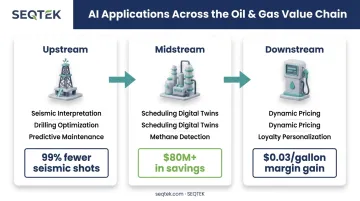
Upstream is where AI shows its sharpest results. Seismic interpretation that once took geologists months now runs through machine learning models trained to spot promising formations in a fraction of the time.
The proof is dramatic. Shell used deep learning to cut the number of seismic shots needed by roughly 99%, compressing a nine-month offshore program into nine days. ExxonMobil saw similar gains, shortening well-planning cycles from nine months to seven.
Beyond exploration, machine learning also:
- Optimizes drilling parameters in real time, adjusting weight-on-bit and rotation speed as formations change
- Refines well spacing and completion design using historical production data and geological modeling
- Flags equipment issues on rigs and pumps before they cause unplanned downtime
That last point matters more than most people realize. On a high-volume offshore platform, just 12 hours of unplanned downtime can defer up to $8 million in production. Predictive maintenance there directly protects quarterly revenue targets.
Midstream and Refining Operations
Refineries run on tight margins, and small scheduling improvements compound fast. AI-driven schedulers and digital twins now model entire refinery workflows in real time, flagging bottlenecks before they show up on a shift report.
BCG documents one Latin American refiner that generated more than $80 million in savings using AI agents for real-time optimization. A global refiner saw similar results, lifting margins by $0.15 to $0.30 per barrel after deploying a scheduling and digital twin system.
On the emissions side, computer vision and sensor networks are changing how operators find leaks:
- DOE-backed research shows continuous monitoring systems detecting methane with precision rates above 96%
- False-positive rates in tested systems have dropped below 3%
- Detection supports, but doesn't replace, EPA-approved monitoring pathways under the agency's 2023 methane rule
Accurate detection doesn't automatically equal regulatory compliance on its own. Operators still need an approved monitoring and response process behind the AI.
Downstream and Fuel Retail
At the retail end, AI shapes pricing, forecasting, and personalization down to the individual station. McKinsey reports that AI-enabled pricing and inventory decisions improved margins by up to $0.03 per gallon in select segments of the roughly 312-billion-gallon US wholesale fuel market.
Retailers are also using AI for loyalty personalization. Morocco's Akwa Group built an AI-driven loyalty app using contextual and transactional customer data, and it climbed to the top of Apple and Google download charts within three months of launch.
How Big Is the AI Market in Oil and Gas?
Market estimates vary depending on scope and methodology, but the direction is consistent. Grand View Research values the global AI-in-oil-and-gas market at $5.29 billion in 2024, projecting it will reach $32.98 billion by 2033 at a 22.9% compound annual growth rate.
Three forces drive that curve:
- Price volatility rewards operators who can model scenarios and adjust operations quickly during major swings—like the one from under $25 to over $100 a barrel.
- Tightening emissions rules, such as the EPA's 2023 methane rule, expand monitoring requirements for existing sources and open the door to advanced detection technologies.
- Looming workforce shortages, with Deloitte finding nearly half of tenured personnel may retire in five to seven years, accelerate the case for automation that doesn't rely on tribal knowledge.
North America leads adoption, accounting for more than 36% of global AI-in-oil-and-gas revenue in 2024. That's not surprising. US shale basins already run on dense sensor networks, and operators there have been investing in digital tools since high-frequency drilling data became standard.
The Business Impact: Key Benefits of AI Adoption
AI's value in oil and gas breaks down into a few categories, and the evidence behind each varies in strength.
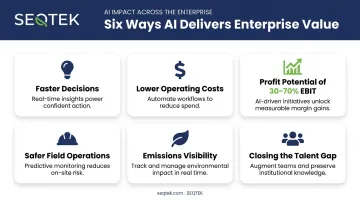
Faster, better decisions. Shell's seismic compression and ExxonMobil's shortened well-planning cycles show what's possible when machine learning replaces manual interpretation. Faster decisions mean faster time to first oil and fewer dry holes.
Lower operating costs. According to BCG's analysis of AI-first oil and gas companies, AI adopters have cut the cost of operating in harsh environments by roughly one-sixth. On predictive maintenance specifically, the math above (12 hours offline, $8 million deferred) shows why that matters.
Real profit potential. BCG projects that companies fully exploiting AI could generate incremental profits equal to 30% to 70% of EBIT over the next five years. That's a forward-looking scenario, not a guaranteed return, but it signals how much value sits untapped in most operations today.
Safer field operations. AI-powered monitoring reduces how often workers need to physically inspect hazardous equipment, and predictive models flag safety risks before they become incidents.
Emissions visibility. AI-supported methane detection gives operators a faster, more precise way to find and fix leaks, supporting ESG commitments and compliance goals at once.
Closing the talent gap. This is the most underrated benefit. As experienced engineers retire, models trained on decades of operational data can preserve some of that institutional judgment, giving newer employees a reference point that used to live only in a veteran's head.
Common Challenges to AI Adoption in Oil and Gas
AI adoption in oil and gas rarely fails because the algorithms don't work. It fails because of what surrounds them.
Cultural resistance. Engineers who've spent decades making decisions on instinct and hard-won field experience are often skeptical of a model telling them where to drill or when to pull a pump. That skepticism is earned, not irrational.
Data foundation gaps. Legacy systems, siloed SCADA platforms, and inconsistent data quality undermine model accuracy before a single AI tool gets deployed. McKinsey's research found that oil and gas companies use less than 1% of the semi-structured data they collect, and data fragmentation remains a scaling barrier for more than half of industry leaders.
Model drift. AI predictions degrade over time as operating conditions and data sources change. Left unmonitored, a model that worked great in year one can quietly become unreliable by year two, which is why continuous retraining isn't optional.
Leadership buy-in. Scaling AI beyond a single pilot requires real investment and tolerance for risk, especially in high-stakes areas like subsurface drilling decisions. Only 30% of oil and gas companies have successfully scaled digital manufacturing initiatives past the pilot stage.
Talent and skills gaps. Most operators don't have in-house data scientists or ML engineers on staff, which makes the build-vs-buy decision unavoidable. Building an internal team takes years. Buying scattered point solutions can create a patchwork of tools that don't talk to each other.
How to Successfully Implement AI in Your Oil and Gas Operations
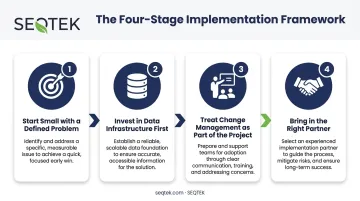
Operators who succeed with AI invest in it as a long-term capability, building the skills, data pipelines, and processes that let models keep improving after the pilot ends. A few practices separate the ones that scale from the ones that stall after the pilot:
- Start small, with a well-defined problem. Predictive maintenance on one equipment class or leak detection on a single facility gives you a bounded test case with measurable outcomes.
- Invest in data infrastructure first. Clean, governed data is the foundation every model depends on. Map your sources, fix quality issues, and assign clear data ownership before scaling.
- Treat change management as part of the project. Training programs and frontline involvement determine whether field teams trust the tool or quietly work around it. McKinsey found that transformations with strong change management are roughly eight times more likely to hit their goals.
- Bring in the right partner if you lack in-house AI expertise. Most operators don't have a bench of idle data scientists, and hiring one from scratch takes months you don't have.
This is where SEQTEK's approach differs from a typical offshore staffing model. Instead of routing AI and data work through a distant team on a different time zone, SEQTEK's Localshoring model embeds AI and data talent directly with your internal teams.
That closer integration cuts the communication delays that slow down conventional outsourced engagements. It also means the people building your models actually understand your operations, not just your specifications.
For oil and gas clients, that has looked like consolidating fragmented SCADA and production data into unified platforms that give operations teams real-time visibility. It has also meant using AI-powered code analysis to modernize legacy systems that had grown too brittle to safely change.
The goal in both cases is the same: build a foundation strong enough that AI actually works once you scale it.
Frequently Asked Questions
How is AI being used in oil and gas?
AI supports seismic analysis, drilling optimization, and predictive maintenance upstream; refinery scheduling and emissions monitoring midstream; and dynamic pricing and personalization at fuel retail locations downstream.
How big is the AI market in oil and gas?
Grand View Research values the global AI-in-oil-and-gas market at $5.29 billion in 2024, projecting a 22.9% CAGR through 2033. Price volatility, tightening emissions rules, and workforce shortages are driving this growth.
What are the biggest risks of implementing AI in oil and gas operations?
The top risks are poor data quality undermining model accuracy, model drift that degrades predictions without retraining, and cultural resistance from teams accustomed to manual, experience-based decisions.
Do small and mid-sized operators need AI, or is it only for large companies?
Scalable, cloud-based AI tools have lowered the barrier to entry, making pilot projects like predictive maintenance or data consolidation realistic for operators of many sizes, not just the majors.
How long does it take to see ROI from AI in oil and gas?
Bounded pilot projects, like a single predictive maintenance use case, can show productivity gains within months. Enterprise-wide transformation, including data infrastructure and change management, takes considerably longer.
What skills or roles are needed to support AI adoption in oil and gas?
Successful adoption typically needs data science, data governance, and change management expertise. Operators without these roles in-house often access them through an embedded technology partner instead of hiring from scratch.