Introduction
Heading into 2026, three forces are colliding for business leaders: AI adoption is accelerating, tech talent remains scarce, and legacy systems are buckling under modern demands. Many companies struggle with software that no longer matches how their teams actually work.
The result is a familiar dilemma. Build an in-house team and absorb steep salary and retention costs. Or outsource to a distant vendor and lose visibility, cultural alignment, and long-term accountability.
There's a better path. This article covers what custom software development actually means, the service types companies need in 2026, and the real benefits backed by data. It also breaks down how the delivery process works, the trends reshaping the industry, and how to pick a partner that won't disappear after launch.
Key Takeaways
- Custom software eliminates licensing bloat and off-the-shelf rigidity in regulated industries.
- Most enterprises run nearly 900 applications, yet only a fraction integrate smoothly.
- AI-assisted coding speeds up development, though results vary by task and team skill.
- Local, embedded delivery models cut the friction common in traditional offshore outsourcing.
What Is Custom Software Development?
Custom software development is the process of designing, building, and maintaining applications tailored to one organization's exact workflows. It's the opposite of commercial off-the-shelf (COTS) software, which is built for the broadest possible market and forces your business to adapt to its logic, not the other way around.
Companies pursue custom builds when:
- Their business logic is too specific for generic templates
- Legacy infrastructure creates constraints that packaged software can't accommodate
- Competitive differentiation depends on proprietary processes competitors can't copy
- Compliance requirements demand controls a one-size-fits-all platform doesn't offer
Custom Software vs. Off-the-Shelf Solutions
The comparison usually comes down to five factors: scalability, licensing costs, flexibility, IP ownership, and total cost of ownership.
| Factor | Custom Software | Off-the-Shelf |
|---|---|---|
| Scalability | Built to grow with your architecture | Often requires costly upgrades or add-ons |
| Licensing | One-time build cost, no per-seat fees | Recurring subscription or per-user fees |
| Flexibility | Shaped around your workflows | You adapt to its workflows |
| IP Ownership | You own the code | Vendor owns the platform |
| Long-term TCO | Lower over time for complex needs | Can balloon with add-ons and seats |
This same trade-off shows up in market data. Grand View Research values the global custom software development market at $43.2 billion in 2024, projecting growth to $146.2 billion by 2030 — a compound annual growth rate above 22%. Forecasts vary between research firms, but the direction is consistent: demand for tailored software is climbing fast.
Regulated and process-heavy industries feel this pressure most:
- Oil and gas companies require field data systems built around rig operations, not generic dashboards
- Banks depend on core systems that satisfy examiners
- Healthcare organizations rely on interoperability that off-the-shelf EHR add-ons rarely deliver
- Airlines demand safety-critical workflows that packaged software wasn't designed for
Types of Custom Software Development Services Companies Need in 2026
"Software development services" is a broader category than most people assume. It spans consulting, discovery, architecture, engineering, quality assurance, deployment, and ongoing support — not just writing code.
Here's what that looks like in practice:
Custom application development. Web, mobile, and desktop solutions built around specific business logic and third-party integrations.
SEQTEK, for example, built a mobile application for an oil and gas company operating rigs near Midland, Texas. Field workers captured operational data on-site and transmitted it directly to headquarters, eliminating follow-up calls to confirm receipt. The result: faster project timelines and sharply improved data accuracy.

Enterprise systems development. Tailored CRM, ERP, and industry-specific platforms designed around actual workflows instead of generic templates. This matters most when your processes don't fit neatly into a vendor's assumptions about how your industry operates.
Legacy system modernization and integration. Connecting outdated infrastructure to modern platforms through APIs and middleware, without forcing a risky full rebuild.
Data, analytics, and AI-enabled development. Predictive analytics, workflow automation, and AI integrations built around your proprietary data, not a vendor's generic model.
Ongoing maintenance, DevOps, and managed support. Keeping systems secure, current, and scalable long after launch. Custom software requires the same ongoing care as any other business-critical infrastructure.
Key Benefits of Custom Software Development for Companies
Custom software solves specific, measurable problems that generic tools can't touch, going well beyond simply having "your own" system.
- Competitive differentiation: Bespoke systems encode proprietary processes and institutional knowledge, so competitors using the same commercial platform can't replicate what's unique to your operation.
- Scalability built for growth: Custom architecture adapts as your business evolves, eliminating workarounds when a commercial platform caps a feature at a certain seat count.
- Seamless integration with existing systems: This is where most companies bleed money. A 2025 Salesforce survey of 1,050 IT leaders found 95% struggle to integrate data across systems, with only 29% of applications actually connected, despite the average enterprise running nearly 900 applications. Custom-built integration architecture closes this gap directly.
- Long-term cost efficiency: No recurring per-seat licensing, no paying for features you'll never use: those savings add up over the life of the software.
- Stronger security and compliance posture: Purpose-built controls for HIPAA, PCI-DSS, or SOX outperform the generic protections baked into platforms built for the widest possible customer base.
- Strategic partnership value: A closely integrated delivery partner accelerates adoption. When the team building your software understands your leadership priorities and daily workflows, solutions stick instead of gathering dust.
The Custom Software Development Process: From Discovery to Deployment
Regardless of who builds it, custom software follows a similar lifecycle:
- Discovery and requirements analysis: mapping current workflows, pain points, and technical constraints before writing a single line of code
- Design and architecture: defining the technical blueprint, data structure, and integration points
- Development and QA: building in iterative cycles with continuous testing, not a single monolithic release
- Deployment: rolling out in phases to minimize disruption to daily operations
- Ongoing evolution: maintenance, updates, and feature expansion as business needs change
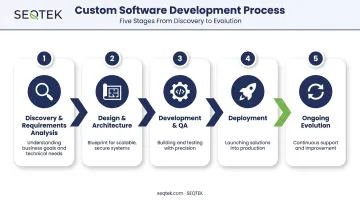
A clear roadmap upfront reduces rework, scope creep, and budget overruns, while skipping discovery to "move faster" almost always backfires later.
Successful engagements depend on a transparent communication cadence. At SEQTEK, that means embedding with your team from day one, not working at arm's length. That looks like:
- Shared documentation both sides can access
- Regular sprint demos, not surprise reveals at the finish line
- Visibility into progress that doesn't require chasing status updates
Top Custom Software Development Trends Shaping 2026
AI-Assisted Development
AI coding tools are changing engineering workflows, but the productivity gains depend heavily on context.
One controlled experiment found developers using GitHub Copilot completed a defined coding task 55.8% faster than those without it. However, a separate 2025 study of experienced open-source maintainers working in repositories they already knew found AI assistance actually slowed completion by 19%.
The takeaway: AI tools accelerate unfamiliar or repetitive tasks more than they help experts working in code they already know intimately. Any partner claiming blanket productivity gains from AI should be pressed on specifics.
Legacy Modernization and Cloud-Native Architecture
Technical debt is catching up with companies that delayed modernization. Cloud-native adoption is now standard practice, with containerized workloads and Kubernetes orchestration running in production across most enterprise environments. Companies are prioritizing incremental modernization that addresses debt without abandoning working systems entirely.
Local, Embedded Delivery Over Traditional Offshore Outsourcing
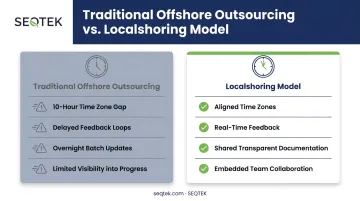
Sourcing relationships are shifting toward closer, more strategic provider partnerships rather than purely transactional cost-cutting arrangements. Companies increasingly want tighter collaboration and faster iteration, which is harder to achieve across large time-zone gaps and cultural distance. This mirrors the Localshoring model SEQTEK has used since 1999, embedding U.S.-based teams directly with client organizations to close those gaps and speed iteration.
How to Choose the Right Custom Software Development Partner
Price shouldn't be the deciding factor. Here's what actually predicts a successful engagement:
- Technical depth and industry experience: Has the partner solved problems specific to your regulatory or operational environment?
- Proven delivery track record: Can they show real examples, not just capability claims?
- Communication model and cultural fit: Do they integrate as an extension of your team, or operate as a distant vendor?
- Orientation toward lasting outcomes: Are they building a relationship, or just finishing a project?
SEQTEK's Localshoring model illustrates this approach directly. Instead of offshore teams working across a 10-hour time difference, Localshoring pairs local talent with embedded partnership. Time-zone friction disappears, documentation stays shared and transparent, and feedback moves in real time rather than overnight batches.
That same proximity has sustained long-term partnerships. Since 1999, SEQTEK has built enterprise relationships with companies including GE, ABB, and ONEOK, backed by more than 25 years of combined team experience. That kind of longevity matters: a partner sticking around for decades has every incentive to build systems that keep delivering value for years to come.
Before signing anything, ask a prospective partner:
- Can you show me a project similar in scope and industry to mine?
- What does your communication cadence actually look like week to week?
- Who owns the code and documentation after delivery?
- What happens if my requirements change mid-project?
Frequently Asked Questions
What are services in software development?
Software development services span the full lifecycle: consulting, discovery, design, engineering, testing, deployment, and ongoing maintenance. The work extends far beyond writing code, covering everything from initial planning to post-launch support.
What is an example of a service as a software?
A subscription-based CRM or accounting platform, like a generic SaaS tool billed per user monthly, is a service delivered as software. Custom software development services, by contrast, build a bespoke system your company owns outright.
What is the difference between custom software and off-the-shelf software?
Custom software is built around your specific workflows and compliance needs, with a one-time development cost and full IP ownership. Off-the-shelf software is faster to deploy but comes with recurring fees and limited flexibility.
How much does custom software development typically cost?
Small to mid-size projects generally range from $30,000 to $100,000. Complex enterprise systems with heavy integrations, security, or compliance requirements often run into six figures, since scope and complexity drive the final cost more than project size.
How long does it take to build custom software?
Simple applications can take a few months, while complex enterprise systems typically take six months to over a year. On average, most software projects take about 13 months from kickoff to launch.
Which industries benefit most from custom software development?
Regulated or complex industries, including healthcare, banking, oil and gas, and manufacturing, see the strongest need. Compliance requirements and process-heavy workflows in these sectors rarely fit neatly into generic commercial platforms.