Introduction
Growing companies face a constant stream of technology decisions: cloud migration, AI adoption, cybersecurity investment, and ERP overhauls. Each one carries real financial risk, and most internal teams do not have the bandwidth to evaluate every option carefully.
The stakes are high. 82% of technology leaders say their companies struggle to realize value from technology investments, according to PwC's 2023 Pulse Survey. This gap spans virtually every industry surveyed.
This article answers three questions: what is technology strategy consulting, what does it actually include, and when does your business need it? We will also cover how it differs from managed IT services and how to pick the right partner.
Key Takeaways
- Technology strategy consulting aligns infrastructure, data, AI, and cybersecurity investments with business goals, not day-to-day IT fixes
- It's distinct from managed IT services, which focus on keeping systems running, not setting direction
- Rapid growth, M&A, rising costs, and compliance pressure are the most common reasons companies engage a strategy consultant
- The right partner offers an unbiased perspective, specialized talent, and a delivery model that fits your team
What Is Technology Strategy Consulting?
Technology strategy consulting is a professional advisory service that evaluates your organization's current technology environment and builds a plan to align it with business goals, growth plans, and risk tolerance. This is the strategic thinking that happens before IT support or software procurement even enter the picture.
The scope is broader than most people assume. Firms like Deloitte and Strategy& define this work as spanning infrastructure, applications, data, AI, and cybersecurity, not just servers and networks. Organizational readiness (people and process) is part of the equation too.
Where Engagements Actually Start
Good engagements don't open with a technology audit. They start with the business:
- What's the growth trajectory over the next 2-3 years?
- How much risk tolerance exists around compliance and security?
- What near-term priorities are non-negotiable?
Only after that context is clear does the technology conversation begin.
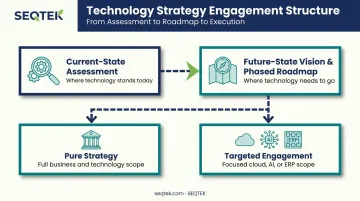
Every solid engagement produces two connected outputs: an honest current-state assessment and a future-state vision, linked by a phased roadmap. Some engagements cover the whole business ("pure strategy")—these are relatively rare. More common are targeted engagements focused on a specific domain: cloud strategy, AI readiness, or ERP direction. Both approaches follow the same underlying logic; they just differ in scope.
What Does Technology Strategy Consulting Include?
Most engagements move through a consistent set of components, from initial assessment through ongoing governance. Here's the breakdown.
Business and Technology Alignment
The first job is translation. High-level business goals (growth, efficiency, customer experience, risk reduction) don't automatically map to specific technology initiatives. Consultants bridge that gap, turning strategic intent into concrete priorities leadership can act on.
Current-State Assessment
This is the audit phase. It looks at infrastructure, applications, security posture, data maturity, and technical debt to surface inefficiencies and blind spots that internal teams often miss simply because they're too close to the systems.
Future-State Vision and Roadmap
Here, consultants define a realistic target state, typically 2 to 5 years out, and sequence initiatives into a phased, budget-aware roadmap. The goal is avoiding two common failures:
- Over-investing in tools that outpace organizational readiness
- Running too many disconnected initiatives at once, creating tech sprawl
Governance and Decision Frameworks
Strategy without governance tends to drift. This component establishes standards, ownership, and metrics so future technology decisions follow a consistent framework instead of being made ad hoc, department by department. It typically includes an architecture standards playbook, defined KPIs, and a recurring review cadence.
Specialized Technology Guidance
Broader strategy work often extends into specific domains, such as cloud migration, AI adoption, ERP/CRM decisions, and cybersecurity architecture. These require specialized talent: architects, engineers, and analysts who understand the technical depth behind the strategic direction.
SEQTEK brings this mix of advisors, architects, and engineers into engagements across cloud infrastructure, AI readiness, and systems integration. This gives clients access to skills they need occasionally but can't justify hiring full-time.
Key Benefits of Technology Strategy Consulting
Every benefit here traces back to one theme: reducing risk and increasing confidence in technology decisions.
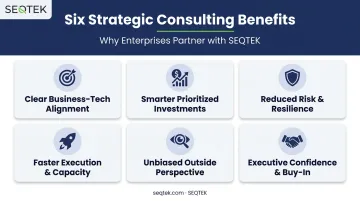
Clear Alignment Between Technology and Business Objectives
When technology decisions map directly to business goals, technology stops being a cost center and starts functioning as a growth enabler. Top-performing organizations are far more likely to get this right. McKinsey's 2026 Global Tech Agenda found that 50% of top performers jointly create strategy across business and technology teams, compared to just 29% of organizations overall.
Smarter, Prioritized Technology Investments
A structured framework prevents redundant tools and low-impact pet projects from eating budget that should go toward high-value initiatives. Instead of funding whatever's loudest, leaders fund what actually moves the business forward.
Reduced Risk and Stronger Resilience
Proactive identification of security, compliance, and operational gaps reduces the odds of breaches, outages, or regulatory trouble down the road. The numbers back this up. Organizations with extensive security AI and automation saw $1.88 million lower average breach costs and breach lifecycles that were 98 days shorter, according to IBM's 2024 Cost of a Data Breach Report.
Faster Execution With Added Capacity
An outside partner brings structure and momentum that internal teams, stretched across day-to-day operations, rarely have room for. That added capacity, plus specialized skills, tends to accelerate delivery timelines meaningfully.
An Unbiased, Outside Perspective
Internal teams develop blind spots. Tribal knowledge dependencies build up quietly over years, and nobody inside the organization is positioned to spot them. A third-party view surfaces these inefficiencies precisely because it isn't tangled up in internal politics or history.
Increased Executive Confidence and Stakeholder Buy-In
A well-documented strategy gives leadership and boards something concrete to point to when funding or defending technology investments. That documentation matters more than most people expect, especially when budgets get scrutinized.
Technology Strategy Consulting vs. Managed IT Services
These two get confused constantly, but they answer different questions. Strategy consulting answers what should we do and why, while managed IT services and basic support answer how do we keep things running today.
| Dimension | Technology Strategy Consulting | Managed IT Services | Basic IT Support |
|---|---|---|---|
| Primary Focus | Direction, priorities, roadmap | Ongoing operation of IT functions | Resolving user issues and requests |
| Time Horizon | Future-state, multi-year | Continuous service relationship | Immediate, recurring |
| Typical Activities | Assessment, architecture, governance, roadmapping | Infrastructure monitoring, contracted service delivery | Troubleshooting, help desk tickets |
| Primary Outcome | Aligned, prioritized technology plan | Reliable day-to-day operations | Issues resolved quickly |
Many organizations use both together: strategy consulting sets the direction, while managed services or internal IT execute the daily work. SEQTEK focuses on the strategy side, not daily IT operations. Neither approach replaces the other.
When Should You Engage a Technology Strategy Consultant?
The need shifts the moment leadership has to make forward-looking decisions about risk, growth, or cost, not just keep the lights on. A few scenarios tend to trigger that shift:
- Rapid growth or expansion: Systems that worked at half your current size start creaking under new demand.
- M&A activity: Combining two technology environments without a plan creates duplicated tools, integration headaches, and hidden risk.
- Rising IT costs with unclear ROI: Spending keeps climbing, but nobody can point to what it's actually buying.
- Compliance or cybersecurity concerns reaching the board: A 2025 Gartner survey found that 90% of non-executive directors lack confidence in cybersecurity value, uncertainty that trickles down and demands board-level action.
Digital transformation initiatives (cloud migration, AI adoption, ERP overhauls) are also common starting points. These efforts frequently become fragmented or expensive when they launch without a strategy foundation first. SEQTEK's Re-Align Workshop was built specifically for organizations where misalignment between leadership, teams, and technology is already slowing things down.
How to Choose the Right Technology Strategy Consulting Partner
Not every consulting firm fits every organization. A few things worth checking before signing anything:
- Industry experience: Look for consultants who've worked in your specific vertical (manufacturing, healthcare, banking, oil & gas) and can point to measurable outcomes across multiple engagements, not just one flagship case study.
- Delivery model: Local, in-region teams cut down on communication delays and time-zone friction that plague distant or offshore models, along with the cultural mismatches that often follow. Proximity produces faster iteration and tighter alignment with your internal team.
- Advisory approach: The best partners transfer knowledge and build internal capability instead of creating dependency. If a firm's business model only works when you keep needing them for everything, that's worth flagging before you sign.
SEQTEK illustrates these criteria in practice. It has operated as a strategic consulting and technology partner since 1999, delivering 500+ projects across airlines, oil & gas, banking, healthcare, and manufacturing. Its "Localshoring" model keeps consulting teams embedded closely with client teams, rather than working remotely across a large time gap, producing faster feedback cycles and better cultural fit.

Frequently Asked Questions
What does an IT strategy consultant do?
An IT or technology strategy consultant assesses your current technology capabilities, aligns them with business goals, and builds an actionable roadmap for future investment and risk management. The focus is direction, not daily operations.
How much does technology strategy consulting typically cost?
Cost varies widely by scope and company size. An assessment-only engagement costs far less than a full roadmap with implementation support, so request a scoped proposal for an accurate estimate rather than relying on generic pricing.
How long does a technology strategy engagement usually take?
Assessments and roadmap development typically take a few weeks to a few months. Full-scale roadmaps spanning 2-5 years get reviewed and refreshed periodically as business priorities shift.
Is technology strategy consulting only useful for large enterprises?
No. Mid-market and growing companies benefit just as much, especially when scaling quickly, going through M&A, or lacking in-house strategic technology leadership.
What's the difference between technology strategy consulting and digital transformation consulting?
Strategy consulting defines the "what and why": direction, priorities, and roadmap. Digital transformation consulting typically focuses on executing the specific modernization initiatives that stem from that strategy.
Do we still need technology strategy consulting if we already have an internal IT team?
Often, yes. Internal IT teams are usually focused on daily operations and often lack the bandwidth or unbiased outside view that strategic consulting provides. It works alongside your team, adding capacity rather than replacing it.