That gap is expensive. A 20-year study by Bridges Business Consultancy found that only 52% of organizations achieved at least half of their strategic objectives — and if the bar is raised to two-thirds of objectives, the failure rate climbs to 85%. The strategy itself usually isn't the problem.
The real issue: leadership sets a bold direction, then departments, teams, and daily workflows keep operating exactly as they did before. Silos persist. Budgets get spent on projects that don't move the needle. This guide breaks down what strategic alignment actually means, the four types you need to diagnose, and a practical framework for building — and sustaining — it.
Key Takeaways
- Strategy documents alone rarely change outcomes; execution requires structural, process, and cultural shifts
- Alignment spans four dimensions: vertical, horizontal, strategic-operational, and cultural
- A six-step framework (clarify, assess, communicate, cascade, build buy-in, monitor) turns strategy into daily action
- Outdated tools and inconsistent communication are the top reasons alignment breaks down
What Is Strategic Alignment?
Strategic alignment is the process of connecting an organization's mission, vision, and goals to its strategies, workflows, and individual roles — so that every level of the business is pulling toward the same outcomes. It's a lived condition that shows up in daily decisions and workflows across the company.
Think of it as a golden thread: a visible, traceable line running from the boardroom's stated strategy down through department priorities, project decisions, and the tasks an individual employee tackles each morning.
When that thread is intact, a warehouse manager can explain how their inventory decisions support a company-wide efficiency goal. When it's broken, that same manager is just following last year's process.
This gap between intent and execution matters more than most leaders realize. MIT Sloan Management Review surveyed 3,200 senior executives and found that only 26% strongly agreed their functional KPIs aligned with organizational strategic objectives. That means roughly three out of four companies are measuring success using metrics that don't actually reflect their stated priorities.
An Example of Strategic Alignment in Action
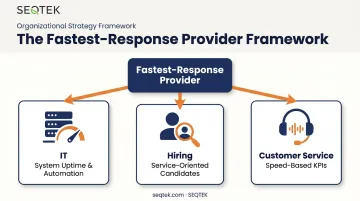
Consider a company that sets a strategic goal to become the fastest-responding provider in its industry. True alignment means:
- IT prioritizes system uptime and support-ticket automation over unrelated feature requests
- Hiring shifts toward candidates who thrive in fast-response environments
- Customer service scripts and KPIs get rebuilt around speed, not just satisfaction scores
Southwest Airlines is a well-known version of this. The company hires explicitly for a service-oriented culture, reviewing hundreds of thousands of applications each year to find people who fit its operating model, not just its job descriptions. That's alignment reaching into a core business process.
Communication alone doesn't create alignment. Telling employees about a new strategy raises awareness. It doesn't restructure incentives, redesign workflows, or shift how decisions get made. That distinction is where most alignment efforts fail.
The 4 Types of Strategic Alignment
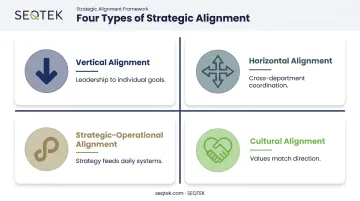
Alignment breaks down in different ways depending on where the disconnect occurs. Diagnosing which type is missing tells you exactly where to focus.
Vertical Alignment
This is the classic top-down cascade: leadership goals translate into departmental targets, which translate into individual objectives. When vertical alignment works, an employee's annual review connects directly to a company-wide priority. When it's missing, teams optimize for local wins that don't actually serve the broader strategy.
Horizontal Alignment
Vertical alignment gets a lot of attention, but horizontal alignment is where most silos live. This is coordination across departments (sales, operations, IT, finance) rather than top-to-bottom.
Research on manufacturing operations found that tightening vertical control while ignoring horizontal coordination often produces conflicting initiatives across business units. Each initiative can look fine in isolation, yet still work against the others.
Strategic-Operational Alignment
This dimension connects long-term goals to the systems people use every day. Kaplan and Norton's balanced scorecard framework describes this as a closed loop: strategy informs operational planning, operations generate data, and that data feeds back into strategic review. Without this loop, strategy stays theoretical.
Cultural Alignment
Values and behavior have to match strategic direction, or the strategy loses. The phrase "culture eats strategy for breakfast" gets attributed to Peter Drucker constantly, though there's no verified record he ever said it. The line actually traces back to a Ford executive around 2006.
Misattribution aside, the idea holds up. McKinsey's 2023 survey of nearly 4,000 employees found organizations with a clear, compelling vision were more than four times as likely to be organizationally healthy than those without one.
Steps to Achieve Strategic Alignment in Your Organization
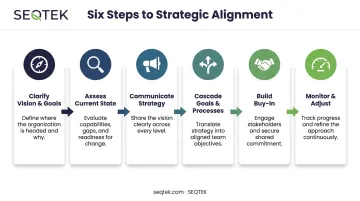
Alignment is an ongoing discipline, not a one-time project you finish. These six steps form a practical, repeatable framework you can revisit as priorities shift.
Step 1: Clarify Vision, Mission, and Strategic Goals
Before any alignment work starts, you need a documented, leadership-endorsed plan with measurable goals, not a vague direction everyone interprets differently. If your leadership team can't agree on the top three priorities in a single meeting, alignment work will just amplify that confusion downstream.
Step 2: Assess Your Current State and Identify Gaps
Evaluate existing structures, workflows, and performance metrics against your strategic plan, and pinpoint where they diverge.
This step benefits from an outside, unbiased perspective, since internal teams are often too close to their own processes to see where disconnects actually live. SEQTEK typically fills this role in client engagements, surfacing blind spots and inefficiencies leadership can't see from inside the organization.
Step 3: Communicate the Strategy Across Every Level
A study by MIT Sloan Management Review covering 124 organizations and over 4,000 respondents found alignment dropped from 51% among top-team members to just 22% among their direct reports. The strongest predictor was managers who consistently explained priorities in both unit-specific and company-wide terms, not simply how often they communicated.
Reinforce this through leadership meetings, dashboards, and onboarding, repeatedly rather than once.
Step 4: Cascade Goals and Align Work Processes
Translate strategic goals into department-level KPIs, redesigned workflows, updated role expectations, and revised reporting lines. This is where the golden thread either holds or snaps. A goal that never becomes a workflow change was never really cascaded.
Step 5: Build Leadership Alignment and Employee Buy-In
Genuine ownership requires linking incentives, performance reviews, and recognition to strategic outcomes, not just announcing the strategy and hoping people care. Gallup research links employee engagement to higher retention and productivity, and alignment is one of the clearest drivers of that engagement.
Step 6: Monitor Progress and Adjust Continuously
Set a cadence for KPI reviews and feedback loops. Kaplan and Norton recommend separating daily/weekly operational check-ins from monthly strategic reviews, since conflating the two causes teams to lose sight of long-term priorities in favor of firefighting.
Common Barriers That Derail Alignment
Even well-designed alignment plans stall for predictable reasons:
- Inconsistent communication: a 2020 Bridges study found 48% of leaders spent less than one day per month discussing implementation, leaving employees working from outdated assumptions.
- Organizational silos: departments optimize locally without coordinating laterally, so strategy fragments across the business.
- Culture and change resistance: leadership commitment that fades after the kickoff meeting undermines even a well-built plan.
- Legacy tools: spreadsheets and static reports can't keep pace with shifting priorities, so misalignment goes undetected for months.
Notably, culture ranked as the lowest-cited reason for implementation failure in the same research. Poor communication and weak measurement systems were bigger culprits. Don't assume culture is always the villain. Sometimes it's simply that nobody built a system to track progress.
Sustaining Alignment: Why Ongoing Partnership Matters
Alignment isn't a one-time initiative you check off. It requires continuous monitoring, recalibration, and leadership discipline long after the initial rollout.
That's where an experienced strategic partner accelerates progress and reduces risk. SEQTEK has worked as a strategic consulting and technology partner since 1999, delivering 500+ projects across aviation, oil and gas, banking, healthcare, and manufacturing. Its Localshoring model embeds accountable teams directly inside client organizations rather than delivering recommendations from a distance.
What that looks like in practice:
- Applying structured change frameworks like ADKAR (Awareness, Desire, Knowledge, Ability, Reinforcement) so alignment sticks after the workshop ends
- Supporting ongoing communication across leadership and frontline teams
- Maintaining accountability structures so commitments turn into measurable action
- Building internal capability through hands-on knowledge transfer, rather than creating long-term dependency
SEQTEK's model centers on leadership alignment and unbiased evaluation, delivered through outcome-based partnership rather than vendor transactions. That distinction matters for organizations that have run strategy off-sites before and watched the energy evaporate within a month. What matters most is someone staying in the room, week after week, keeping the plan from unraveling.

Frequently Asked Questions
What is strategic alignment?
Strategic alignment is the process of integrating an organization's mission, vision, and goals into its strategies, processes, and individual roles. It ensures every level of the business (leadership, departments, and employees) works toward the same measurable outcomes.
What are the 4 types of alignment?
The four types are vertical (goals cascading from leadership), horizontal (cross-department coordination), strategic-operational (daily work supporting long-term goals), and cultural (values matching strategy). Each targets a different failure point in execution.
What is an example of strategic alignment?
A company pursuing a "fastest response time" strategy aligns IT investment toward system uptime, hiring toward service-oriented candidates, and customer service KPIs around speed. Southwest Airlines' culture-based hiring model is a widely cited real-world example.
What are the 5 C's of strategy implementation?
One well-known implementation framework outlines Causality, Criticality, Compatibility, Continuity, and Clarity. Together, they ensure actions have a clear link to strategy, resources focus on high-impact work, and priorities stay specific enough to execute.
How long does it take to achieve strategic alignment?
Initial cascading and communication typically take two to four months per organizational tier, according to the Balanced Scorecard Institute. Full alignment, however, is an ongoing process rather than a project with a fixed end date.
Who is responsible for strategic alignment in an organization?
Senior leadership sets the strategic direction, but genuine alignment requires shared accountability across managers, teams, and individual employees. Without buy-in at every level, even a well-communicated strategy stays disconnected from daily work.