That shift is expensive, and it's happening fast. Gartner forecasts worldwide AI spending will hit $2.52 trillion in 2026, a 44% jump year over year. For enterprise leaders, sitting on the sidelines isn't a neutral choice anymore. It's a competitive risk.
This article breaks down the trends defining enterprise AI in 2026, the forces pushing them forward, how they're reshaping operations and workforces, and what to watch next.
TL;DR
- Enterprise AI is moving from experimentation to production-scale, agentic deployment
- Regulated industries like finance, healthcare, and manufacturing are leading AI adoption today
- AI governance and risk management have become board-level concerns
- Companies with a formal AI strategy and change management plan outperform those without one
- The gap between AI "frontier" organizations and everyone else is widening fast
Key Enterprise AI Adoption Trends for 2026
These five shifts represent the biggest changes enterprises need to prepare for this year.
From Pilots to Production-Scale Deployment
The proof-of-concept era is ending. Enterprises are pushing AI out of sandbox environments and into live, department-spanning workflows.
McKinsey's 2025 global survey found 88% of organizations now use AI in at least one business function, yet nearly two-thirds haven't started scaling it across the enterprise. That gap between access and scale is the real story of 2026.
Why it matters: pilots generate headlines. Production deployment generates ROI. Companies stuck running dozens of small pilots without ever operationalizing them are the ones falling behind, regardless of how much they've experimented.
Rise of Agentic AI in Business Workflows
AI has moved past answering questions. It now completes multi-step tasks with minimal human intervention, acting less like a copilot and more like an active participant.
The fastest traction is showing up in two areas:
- Coding: An OpenAI survey of 9,000 workers found 73% of engineers shipping code faster, with non-technical staff increasingly writing code too
- Customer support: Salesforce reports AI-agent adoption in service jumped from 39% to 66% in a single year
This matters because agentic AI changes the operating model itself. Instead of a person prompting a tool for a single answer, an agent now owns a workflow from start to finish, with a human checking the output rather than performing the task.
Regulated and Traditionally Slow-Moving Industries Leading Adoption
Financial services, healthcare, and manufacturing spent years being cautious, cited as the industries most hesitant to move fast on new technology. That reputation no longer holds.
- More than 80% of physicians now report using AI professionally in their work
- 80% of manufacturing executives surveyed plan to dedicate at least 20% of improvement budgets to smart manufacturing initiatives
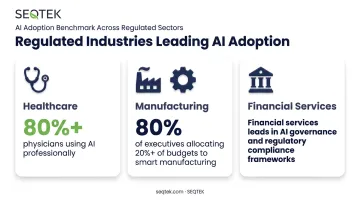
This is directly relevant to SEQTEK's core industries: oil & gas, banking, and healthcare. Strong governance is now the reason these sectors can move faster with confidence, not an obstacle slowing them down.
SEQTEK has seen this firsthand, including a healthcare project where compliance was built directly into data workflows rather than bolted on afterward, and an oil & gas modernization effort where the lesson was blunt: AI is a force multiplier only when guided by clear standards and architectural discipline.
AI Governance and Risk Management Become Board-Level Priorities
As AI usage deepens, formal governance covering data privacy, explainability, and audit trails is becoming table stakes rather than a nice-to-have.
The NIST AI Risk Management Framework, organized around Govern, Map, Measure, and Manage, has become a reference point for enterprises building these controls. Banco do Brasil offers a concrete example: it implemented an AI governance platform with EY-designed processes to automate lifecycle oversight and enable real-time monitoring across its AI systems.
Yet the gap here is wide. Deloitte reports only 20% of companies have a mature governance model for autonomous agents, despite aggressive deployment plans. Ungoverned AI sprawl creates more than technical debt: compliance exposure, security risk, and reputational damage that are much harder to unwind after the fact.
Strategic, People-First Adoption Replaces Ad Hoc Experimentation
People and process drive adoption, not technology alone, and the data makes this clear.
BCG surveyed more than 10,600 leaders, managers, and frontline employees and found that with strong leadership support, employee positivity toward generative AI rose from 15% to 55%. That's a massive shift — the difference between a stalled rollout and one that actually sticks.
This is exactly where experienced partners earn their keep. SEQTEK's Localshoring model pairs embedded local talent with structured change management, built on the ADKAR framework (Awareness, Desire, Knowledge, Ability, Reinforcement).
The goal is helping organizations translate AI strategy into systems people actually use, instead of initiatives that stall within six months of launch. Leadership is realizing that a great model deployed into a resistant, unprepared workforce is still a failed project.
What's Driving These AI Adoption Trends
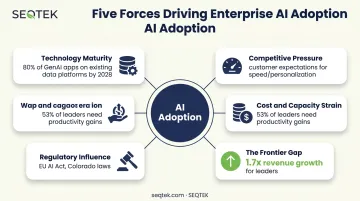
Several forces are converging to accelerate enterprise AI adoption in 2026, from technology maturity and competitive pressure to workforce strain, regulation, and widening performance gaps.
- Technology maturity: Gartner predicts 80% of generative AI business applications will be built on existing data platforms by 2028, cutting delivery time and complexity roughly in half
- Competitive pressure: Customers now expect AI-powered speed and personalization as standard, pushing slower companies to close the gap or lose market share
- Cost and capacity strain: Research shows 53% of leaders say productivity must increase, while 80% of workers lack the time or energy to keep pace, pushing companies to automate repetitive work
- Regulatory influence: Emerging AI laws, including the EU AI Act's phased rollout and Colorado's automated-decision requirements, are shaping where and how enterprises deploy AI, especially in regulated sectors
- The frontier gap: McKinsey research finds companies furthest ahead on AI achieve 1.7x revenue growth and 1.6x EBIT margins over laggards, raising the cost of standing still
How These Trends Are Impacting the Enterprise Landscape
These shifts are producing measurable, cross-functional change, not just headlines.
Operational Impact
Support desks, coding teams, and back-office functions are being redesigned around AI-first workflows instead of AI as an add-on tool.
The payoff is real for regular users. 42% of frontline employees using AI regularly report saving at least eight hours per week, close to a full workday. The catch: those hours only create value if they're redirected to meaningful work rather than absorbed into busywork elsewhere.
Business Impact
Investment priorities are shifting away from one-off tools toward AI infrastructure, governance platforms, and long-term vendor partnerships.
This mirrors the widening performance split between heavy AI investors and everyone else. Firms leading on AI restructure how spending gets allocated, favoring integrated ecosystems over scattered point solutions that never scale past a single team.
Workforce Impact
Rolling out AI without alignment creates real friction between IT, leadership, and employees, and that friction shows up in the data.
Harvard Business Review found 76% of executives believe employees are enthusiastic about AI, while only 31% of individual contributors actually report that enthusiasm, a 45-point perception gap. Closing that gap usually comes down to two things: naming AI champions who can translate strategy into daily practice, and investing in reskilling.
Employees need to see AI as a tool that extends their role rather than replaces it. SEQTEK's change management and leadership development work often centers on exactly this: equipping managers to model AI adoption instead of just mandating it.
Future Signals for Enterprise AI in 2026 and Beyond
Adoption patterns will keep shifting. Here's what enterprise leaders should track over the next one to three years:
- Multi-agent systems now top Gartner's strategic trend list, with 81% of leaders expecting deep AI-strategy integration within 12-18 months.
- Airlines and heavy industry are applying proven playbooks from early aviation and manufacturing adopters, moving AI from pilot projects into daily operations.
- Regulatory pressure builds: EU AI Act transparency rules begin August 2026, with high-risk rules phasing in through 2028; Colorado and other US states add compliance requirements starting 2027.
Conclusion
2026's defining trends are clear: production-scale deployment, agentic AI, regulated-industry leadership, board-level governance, and people-first adoption strategies. Together, they're rewriting how enterprises compete.
Organizations that move early, with real strategy and real change management behind them, are building a lasting edge over those still treating AI as a side project. SEQTEK partners with organizations at this stage, turning AI strategy into systems that employees actually adopt.
That focus on adoption, not just investment, is what separates 2026's leaders from the rest. Budget alone won't create that edge; pairing it with the foresight to prepare people will.
Frequently Asked Questions
How are enterprises adopting AI?
Most enterprises move through stages: exploration, isolated pilots, department-level integration, and finally organization-wide, strategy-led deployment. High-volume, well-defined use cases like customer support and coding tend to come first.
What are the four levels of AI adoption?
A common maturity framework includes awareness and foundation, active pilots and skill building, operational integration and governance, and full enterprise-wide transformation. Most organizations today sit somewhere between experimentation and operational integration.
What is the 30% rule in AI adoption?
There's no single "30% rule." The most cited version comes from Gartner, which predicted at least 30% of generative AI projects would be abandoned after proof of concept by 2025 due to poor data or unclear business value.
What percentage of enterprises have adopted AI in 2026?
Roughly 88% of organizations use AI in at least one function, according to McKinsey. That figure includes light experimentation, though, so it shouldn't be mistaken for 88% running fully scaled AI systems.
Which industries are leading AI adoption in 2026?
Financial services, healthcare, legal, manufacturing, and technology lead current adoption data. These sectors combine high-volume repetitive work with strong existing data infrastructure, making them well-suited to fast, governed AI rollout.
How can enterprises ensure successful AI adoption?
Success depends far more on strategy and people than on the technology itself. A formal AI roadmap, structured change management, and an experienced implementation partner, such as SEQTEK's Localshoring team, consistently separate lasting adoption from stalled pilots.