In 2026, that redesign work looks different. AI-powered process mining, agentic automation, and hybrid work are changing what "radical redesign" actually involves. Many leaders struggle to tell the difference between a genuine BPR initiative and a simple software upgrade dressed up in new language.
Companies that misjudge this distinction waste budget on piecemeal fixes instead of structural change. Understanding where BPR is actually heading in 2026 helps leaders avoid that trap, modernize with intent, and stay ahead of competitors who are still patching old systems.
This article breaks down what BPR means today, the trends reshaping it, and how to execute it without the common missteps that sink transformation projects.
Key Takeaways
- BPR means a radical, end-to-end redesign, not incremental fixes like Six Sigma or BPI
- AI-driven process mining and agentic automation now reshape how organizations discover and redesign workflows
- Cloud and ERP modernization now serve as the technical backbone for reengineered processes
- Strong change management and the right execution partner determine whether a redesign actually sticks
What Is Business Process Reengineering (BPR)?
BPR is the fundamental rethinking and radical redesign of business processes to achieve dramatic gains in cost, quality, service, and speed. Tweaking a workflow step or trimming a form doesn't qualify. Real BPR questions whether the process should exist in its current form at all.
That distinction matters. A team that automates a broken approval chain hasn't done BPR. They've just made a bad process faster.
Origin and Evolution of BPR
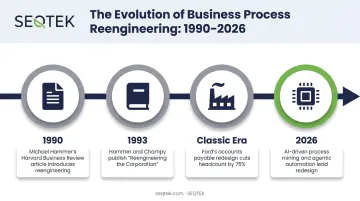
Michael Hammer introduced the concept in his 1990 Harvard Business Review article, "Reengineering Work: Don't Automate, Obliterate," where he argued that companies were wasting money automating obsolete work instead of eliminating it. Three years later, Hammer and James Champy expanded the idea into their book Reengineering the Corporation, cementing Hammer's reputation as the father of BPR.
The classic example still holds up: Ford redesigned its accounts payable process to eliminate invoices entirely, matching purchase orders directly against receiving data. The result was a 75% reduction in accounts payable headcount.
BPR has since moved from manual, paper-based redesign (think early banking workflows) into a technology-enabled discipline. Heading into 2026, AI has become the primary tool for discovering and rebuilding these processes, but the underlying principle from Hammer's original article hasn't changed.
BPR vs. Related Methodologies
BPR often gets confused with improvement methods that operate on a completely different scale.
| Approach | Scope | Typical Use Case |
|---|---|---|
| BPR | Radical, end-to-end redesign | Replacing an outdated process entirely |
| Six Sigma / BPI | Incremental, variation-reducing improvement | Reducing defects in an existing process |
| ERP | Technology platform | Enabling or supporting a redesigned process |
BPI and Six Sigma work within the existing process structure to reduce waste and variation. BPR throws out the structure and starts over. Neither approach is "better" universally; they solve different problems.
ERP causes similar confusion. ERP is a technology platform, and organizations frequently install it expecting the software to fix broken processes automatically. It doesn't. BPR is the strategic redesign work that should happen before or alongside an ERP rollout, not a substitute for it.
Key Business Process Reengineering Trends Shaping 2026
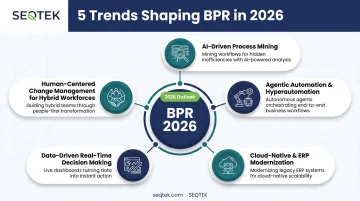
The trends shaping BPR in 2026 center on five forces: AI-powered discovery, autonomous automation, cloud-native modernization, real-time data decisioning, and workforce redesign. Process mapping alone no longer cuts it.
AI-Driven Process Mining and Intelligent Discovery
Manual process documentation used to eat weeks of a transformation project. AI and machine learning-powered process mining tools now pull directly from system logs to map workflows automatically, showing exactly where bottlenecks and redundant steps occur.
Adoption is still building momentum. Deloitte's 2025 Global Process Mining Survey found that **25% of organizations currently use AI alongside process mining**, while 74% plan to adopt it in future initiatives. That gap between current use and stated intent tells you this is an emerging capability, not a settled standard.
Agentic Automation and Hyperautomation
Traditional automation handles single tasks. Agentic AI goes further, autonomously executing and coordinating multi-step processes without a human directing each action.
Adoption here is real but still early-stage. McKinsey's 2025 State of AI survey found **62% of organizations experimenting with AI agents**, but only 23% have scaled an agentic system anywhere in the enterprise. No single business function crossed 10% at scale.
That's the gap leaders need to understand: plenty of pilots, far fewer production deployments.
Cloud-Native and ERP Modernization
Legacy infrastructure can't support a redesigned process. Organizations are re-platforming to cloud-native systems as the foundation for BPR, not as an afterthought.
CDW's finance transformation offers a useful example. The company replaced legacy ERP processes that required manual data extraction with a connected cloud platform linking finance and HR data, redesigning finance operations around automation instead of manual manipulation.
This mirrors what SEQTEK sees across aviation, energy, and banking clients: modernization only pays off when it's paired with a redesigned process, not bolted onto the old one.
Data-Driven, Real-Time Decision Making
Redesigned processes increasingly build in predictive analytics and live dashboards, replacing after-the-fact reporting with in-the-moment decisions.
SEQTEK's work with an oil and gas client in Midland, Texas illustrates this shift. Field engineers previously had to make redundant verification calls to confirm data reached headquarters. After redesigning the workflow around real-time data capture, communication between field crews, rig workers, and headquarters became fully synchronized, and project timelines shortened as a result.
Human-Centered Change Management for Hybrid Workforces
Real-time dashboards only pay off if the teams using them can actually collaborate. BPR in 2026 isn't only about cost. It's increasingly about redesigning processes so distributed and hybrid teams can actually work together without friction.
SEQTEK's airline automation project shows this in action. Ground crews and pilots previously relied on a legacy tablet system that required manual paperwork, creating delays between the two teams. The modernized platform created a real-time workflow connecting ground operations directly to the cockpit, cutting out the manual steps that slowed everyone down.
What's Driving These BPR Trends
Several converging pressures are pushing companies toward radical redesign instead of small fixes.
- Technology advances: Generative and agentic AI, IoT sensors, and automation platforms have slashed redesign costs. Work that once took years now happens in months
- Market demand: Customers expect faster service and personalized experiences, exposing legacy processes that simply weren't built for speed
- Cost pressures: Rising labor costs and tighter margins compel organizations to eliminate inefficiencies at scale rather than trim them at the edges
- Regulatory shifts: Expanding data privacy and compliance requirements force companies to redesign how they collect, store, and report information
- Competitive dynamics: Digital-native competitors move faster than incumbents weighed down by legacy systems, leaving slower companies with no choice but to reengineer
None of these pressures act alone. A company facing labor shortages and rising customer expectations at the same time doesn't have room for incremental fixes. That combination is exactly what pushes BPR from "nice to have" to "necessary."
How These Trends Are Impacting Businesses
These forces are producing measurable shifts across operations, strategy, and workforce structure.
Operational Impact
Redesigned processes are producing shorter cycle times and fewer manual handoffs. SEQTEK's oil and gas engagement in Midland shows this directly: eliminating redundant verification calls between field engineers and headquarters saved time and improved data accuracy across the entire operation.
System-driven task routing is replacing manual coordination in similar fashion across aviation, banking, and manufacturing clients, cutting the phone and email delays that once slowed handoffs between teams.
Business Impact
Companies are shifting investment toward AI and automation platforms, but they're also changing how they buy. Outcome-based vendor partnerships, where payment ties to results rather than hours billed, are becoming more common than traditional project-based contracts.
This shift reflects a broader lesson from BPR history: process redesign that isn't tied to measurable outcomes tends to stall before it delivers value.
Workforce Impact
Roles are shifting toward process and AI literacy. Teams that once specialized narrowly now need to understand how automated systems interact with their daily work.
Change management demands are rising in parallel. Organizations that skip this step tend to see the technology work but the adoption fail, a gap that shows up repeatedly in failed transformation efforts.
Overcoming BPR Challenges and Choosing the Right Partner
BPR projects fail for predictable reasons:
- Employee resistance to changes that threaten familiar routines or job security
- Incomplete process documentation, meaning teams redesign based on assumptions instead of facts
- Unrealistic timelines or scope, often driven by leadership pressure to show fast results
The fix for resistance starts earlier than most companies think. Involving employees in workshops and interviews before the redesign begins, not after, surfaces bottlenecks that leadership often can't see. Visual process-mapping tools make abstract workflows concrete, giving teams something tangible to react to and improve.
Frameworks like ADKAR (Awareness, Desire, Knowledge, Ability, Reinforcement) help structure that resistance management systematically rather than hoping goodwill carries the project through.
Most organizations don't attempt BPR alone, and for good reason. An outside partner brings:
- An unbiased assessment, free from internal politics or sunk-cost thinking
- Specialized talent across process design, technology architecture, and change management
- Structured methodology instead of ad hoc problem-solving
This is where execution model matters as much as the redesign itself. SEQTEK's Localshoring model pairs embedded, local talent with deep process and technology expertise, reducing the communication delays and cultural friction that often derail fully outsourced engagements.
Because the team works in close alignment with the client's own people, adoption tends to match how the organization actually operates, not how an outside vendor assumes it should.
BPR trends in 2026 are shaping who wins and who falls behind. Organizations that act early, with a clear strategy and the right partner, will out-execute those still waiting for the "right time" to start.
Frequently Asked Questions
What are the 7 steps of business process reengineering (BPR)?
Frameworks vary, but common steps include refocusing on customer value, simplifying workflows, automating where it makes sense, modernizing systems, and reorganizing into cross-functional teams. There's no single universal standard.
What is the difference between ERP and business process reengineering (BPR)?
BPR is a strategic redesign methodology for rethinking how work gets done. ERP is the technology system that supports and enables those redesigned processes once they're defined. One is strategy, the other is infrastructure.
What are the 3 R's of business process reengineering?
The 3 R's (Rethink, Redesign, Retool) are shorthand for the BPR approach, not part of Hammer's original terminology. They capture the sequence: question the process, rebuild it, then equip it with technology.
Who is known as the father of business process reengineering (BPR)?
Michael Hammer earned that title after publishing his 1990 Harvard Business Review article, followed by the 1993 book Reengineering the Corporation, co-authored with James Champy. Both remain foundational texts on the topic.
Is business process reengineering still relevant in the age of AI?
Yes. AI has made BPR faster and more accessible by automating process discovery and enabling autonomous execution. It hasn't replaced the need to rethink how work should be structured in the first place.
How long does a business process reengineering project typically take?
Timelines vary widely by scope. A single-process redesign might take a few months, while enterprise-wide transformation can extend well beyond a year depending on organizational size and complexity.