Introduction
Every leadership team is under pressure to do more with fewer resources, especially as AI and new technology reshape what "efficient" even means. The problem is that most companies are trying to modernize while running on processes built for a different era.
That mismatch is expensive. Deloitte's 2025 research found that 41% of employees' time goes to work that doesn't contribute to organizational value at all, and only 22% of organizations say they're highly effective at simplifying work.
This article breaks down what business process optimization consulting actually involves: the warning signs it's time to call someone in, and how to pick a partner who won't just hand you a report and disappear.
SEQTEK has done this work with organizations since 1999, pulling insights from practice, not just theory.
Key Takeaways
- Process optimization diagnoses inefficiencies and redesigns workflows using Lean, Six Sigma, and BPR
- Recurring bottlenecks, inconsistent workflows, and low morale signal it's time for outside help
- A proven engagement flows through assessment, mapping, root cause analysis, redesign, and monitoring
- Local delivery models cut communication friction that offshore teams often introduce
- Done right, expect measurable gains in speed, cost, quality, and employee experience
What Is Business Process Optimization Consulting?
Business Process optimization consulting is the practice of analyzing how work actually gets done, then redesigning those workflows to cut waste, reduce errors, and improve output quality. It goes beyond tweaking a few steps here and there, taking a structural look at how information, approvals, and handoffs move through your organization.
The distinction between the two matters:
| Approach | What It Means |
|---|---|
| Process improvement | Incremental fixes: a bottleneck resolved, a form adjusted, an approval chain tightened |
| Process optimization | Continuous and technology-enabled restructuring, tied to automation or new systems, aimed at sustained gains rather than one-time fixes |
Consultants bring something internal teams usually can't: an outside perspective free of office politics and the habitual blind spots that build up over years of "that's just how we do it here."
Common Methodologies Consultants Use
Most experienced consultants pull from a handful of proven frameworks, blending them based on where a client currently stands:
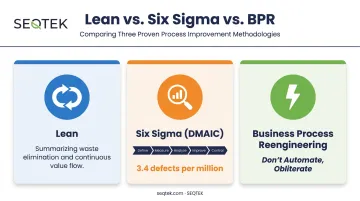
- Lean: focuses on eliminating non-value-added steps and waste from a workflow
- Six Sigma (DMAIC): a data-driven method (Define, Measure, Analyze, Improve, Control) aimed at reducing defects and inconsistency; Six Sigma targets no more than 3.4 defects per million opportunities
- Business Process Reengineering (BPR): a more radical redesign approach, famously summarized in a 1990 Harvard Business Review article as "Don't Automate, Obliterate"
A mature manufacturing floor might need Six Sigma's statistical rigor. A startup drowning in manual approvals might just need Lean thinking applied fast. Good consultants read the room before picking a framework, not the other way around.
Signs Your Business Needs a Process Optimization Consultant
Some warning signs are obvious. Others hide in plain sight until someone points them out.
Watch for:
- Recurring bottlenecks in the same three or four spots, no matter who's staffing them
- Missed deadlines that keep getting blamed on "one-off" circumstances
- Inconsistent processes across departments doing similar work
- High rework or waste, where teams redo tasks that should've been right the first time
- Low employee engagement tied to friction, not workload
The scale of this problem is bigger than most leaders assume. McKinsey research shows cross-cutting management processes consume 40-65% of management and overhead time at many organizations. That's not a rounding error. That's half your leadership bandwidth spent on friction instead of strategy.
Here's what surprises most leadership teams: the real trigger usually has nothing to do with a broken process.
Internal teams simply lack the bandwidth or specialized expertise to fix things properly while running the business day-to-day. Nobody has time to fix the plane while flying it.
Key Benefits of Business Process Optimization Consulting
When optimization is done well, the gains show up in five distinct places.
Increased efficiency and productivity. Eliminating redundant steps directly speeds up cycle times. A common example: an approval chain requiring five signatures gets redesigned down to two, cutting turnaround from days to hours.
Cost reduction. Automation and waste elimination lower operational overhead. A major European bank transformed its top 15 end-to-end processes and cut costs by 35%, while lifting its net promoter score by 40%. That's a clear sign cost savings and customer experience can improve simultaneously.
Improved quality and customer satisfaction. Standardized processes mean more consistent output. Fewer surprises for clients. Fewer escalations for support teams.
Reduced risk in decision-making. Data-driven analysis and expert evaluation catch costly missteps before they happen, rather than after a bad quarter forces the conversation.
Scalability. Optimized processes handle growth without proportionally adding headcount or complexity. That matters more than most growth-stage companies realize until they hit a wall.
Industries That Gain the Most
Certain sectors face bottlenecks that make optimization consulting especially valuable:
- Airlines: turnaround delays and planning inefficiencies
- Oil & gas: safety compliance and asset throughput
- Banking: regulatory compliance and manual document processing
- Healthcare: patient flow and care coordination
- Manufacturing: production line waste and quality defects
On that last point, NIST's Manufacturing Extension Partnership has delivered more than 80,000 lean manufacturing projects, helping manufacturers save over $18.8 billion collectively. That scale makes process optimization a competitive necessity across manufacturing, not a specialty practice.
How the Consulting Engagement Works: A Step-by-Step Process
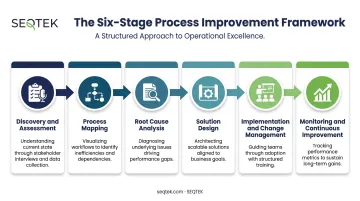
A good engagement doesn't jump straight to solutions. It follows a sequence designed to diagnose before it prescribes.
Discovery and Assessment: Consultants conduct stakeholder interviews and review current-state performance metrics to understand what's actually happening, not just what the org chart says should be happening.
Process Mapping: Consultants map workflows end-to-end, exposing handoff delays and bottlenecks that rarely show up in a status meeting.
Root Cause Analysis: Data and direct observation pinpoint the actual source of inefficiency, not just the symptoms everyone already complains about.
Solution Design: Consultants redesign workflows, paying specific attention to where automation or new technology genuinely adds value (and where it doesn't).
Implementation and Change Management: Consultants train teams and, just as importantly, communicate the why behind new processes. Skipping this step is the fastest way to trigger quiet resistance instead of buy-in.
Monitoring and Continuous Improvement: Consultants set and track KPIs so gains stick around after the engagement ends, rather than fading back to old habits within a quarter.
How to Choose the Right Business Process Optimization Consulting Partner
Not all consulting partners deliver the same value. A few factors separate the ones worth hiring from the ones you'll regret.
Prioritize proven industry experience. A consultant fluent in Lean and Six Sigma but unfamiliar with your regulatory environment will burn weeks getting up to speed on things a specialist already knows.
Evaluate the delivery model carefully. This one gets overlooked constantly. Offshore and nearshore teams introduce time-zone friction, communication delays, and cultural gaps that slow everything down.
SEQTEK's Localshoring model, based in Tulsa, Oklahoma, was built specifically to avoid that. Consultants work in the same time zones and business context as the client, which means:
- Same-day responsiveness instead of overnight delays
- Fewer misunderstandings tied to cultural or communication gaps
- Faster feedback loops that keep projects moving
Look for knowledge transfer, not dependency. The best partners want your team capable of sustaining improvements on their own after the engagement ends. If a consultant's business model depends on you needing them forever, that's a red flag worth noticing.
Check the track record. Ask for specifics: years in business, number of projects delivered, and the types of clients served.
SEQTEK, for example, has spent 25+ years delivering 500+ projects for enterprise clients including GE, ABB, and ONEOK. That kind of proof point tells you more than a polished pitch deck ever will.
Frequently Asked Questions
What is a process optimization consultant?
A process optimization consultant is a professional who analyzes existing workflows, identifies inefficiencies, and helps redesign and implement improved processes. Their goal is boosting efficiency, cutting waste, and improving output quality.
What is the difference between process improvement and process optimization?
Process improvement refers to incremental fixes to an existing workflow. Process optimization is a broader, often technology-enabled restructuring aimed at continuous, sustained gains rather than one-time adjustments.
How much does business process optimization consulting typically cost?
Cost varies based on project scope, complexity, and engagement length, so there's no universal number. The better question is ROI: measure the investment against the efficiency and cost-saving gains it produces, not just the upfront price.
How long does a typical process optimization engagement take?
Timelines range widely. A single workflow fix might take a few weeks, while an enterprise-wide transformation across multiple departments can take several months. Scope drives duration more than anything else.
Which industries benefit most from process optimization consulting?
Industries with complex, high-stakes workflows tend to see the biggest gains, including healthcare, manufacturing, banking, energy, and aviation. These sectors combine regulatory pressure with operational complexity, making inefficiency especially costly.
Can small businesses benefit from process optimization consulting, or is it only for large enterprises?
Businesses of any size dealing with scaling pains or inconsistent processes can benefit. Smaller organizations typically see value through a narrower, smaller-scope engagement rather than a full enterprise transformation.