

If that resonates, you're not alone. Gallup's data shows that only 32% of U.S. employees are engaged at work, with nearly half considered psychologically detached from their roles. For experienced professionals, that gap between capability and contribution is often the first real signal that a different path might fit better.
This article covers 7 specific, recognizable signs that independent business consulting may be the right next step — along with honest context about what it actually takes. Recognizing these signs doesn't mean quitting tomorrow. It means the conversation is worth having.
Key Takeaways
- Independent consultants sell expertise and judgment — not task execution — across multiple clients simultaneously
- The 7 signs range from feeling underutilized to craving entrepreneurial ownership
- Going independent demands financial, legal, and mindset preparation — not just a career change of scenery
- BLS projects management analyst employment to grow 9% through 2034, reflecting sustained organizational demand for specialized expertise
What Is an Independent Business Consultant?
An independent business consultant is a self-employed professional who works with multiple clients on a contract basis, providing expert advice in a defined area. Unlike an embedded employee or generalist contractor, they come in from the outside.
The distinction that matters: consultants sell insight and outcomes, not hours. Their value increases when the problem is ambiguous, the stakes are high, and the client doesn't yet know what they need. That's fundamentally different from a contractor, who executes defined tasks within a known scope.
In practice, independent consultants typically:
- Diagnose organizational challenges before recommending solutions
- Develop strategies and advise leadership on technology, operations, or transformation
- Work across industries — manufacturing, healthcare, oil and gas, financial services — where the problems are complex and the cost of getting them wrong is significant
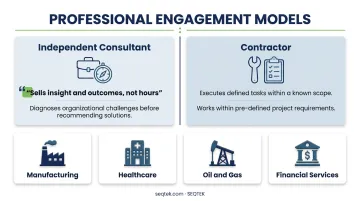
If you're weighing whether this path fits you, the definition is only the starting point. The real question is whether your experience, mindset, and working style align with what clients in those sectors actually need from an outside advisor.
7 Signs You Should Become an Independent Business Consultant
Sign 1: You Feel Like You're Not Reaching Your Full Potential
You're competent. Possibly recognized. But a ceiling exists — imposed by hierarchy, internal politics, or a scope that was defined before you arrived. Your best thinking rarely makes it to the decisions that matter.
Independent consulting removes that ceiling directly. When your income and reputation depend on the results you generate for clients — not the grade level you occupy — your actual capabilities finally become the measure. The impact you create is yours.
Sign 2: You Have Deep, Specialized Expertise (Not Just Skills)
Skills are teachable. Expertise is accumulated. If you've seen a specific type of problem repeatedly — and can solve it faster, more accurately, and with better judgment than someone encountering it for the first time — that's expertise. And that's what clients pay for.
Consulting buyer research consistently identifies relevant experience and subject-matter expertise as primary selection criteria. Clients don't hire independent consultants to execute tasks. They hire them to say what should be done and why.
Sign 3: You Want Control Over Who You Work With and How
In independent consulting, control is real and tangible:
- Choose your clients — pursue the industries and problem types you find genuinely interesting
- Select your engagements — say no to work that doesn't fit your expertise or values
- Design your process — structure engagements around how you work best, not inherited procedures
- Set your schedule — within client commitments, own your time
The honest counterpart: no one assigns work, and no paycheck arrives automatically. For professionals who thrive when given ownership, this trade-off is energizing. For those who prefer structure delivered from above, it's a genuine challenge worth examining before committing.
Sign 4: You've Stopped Learning and Growing
When every week feels like a repeat of the last — same project types, same internal dynamics, same constraints — growth has stopped. Pew Research found that 63% of workers who voluntarily left jobs in 2021 cited lack of advancement opportunities as a reason. Stagnation is a common exit trigger.
Independent consulting forces continuous learning by design:
- Every client brings a new organizational context and new stakeholders
- Every engagement surfaces problems you haven't encountered in exactly that form before
- Running your own practice adds business development, client communication, and financial management to your development agenda — skills that corporate roles rarely demand
The learning curve doesn't plateau. If that sounds energizing rather than exhausting, it's a meaningful signal.
Sign 5: You Want Income That Reflects the Value You Create
Employee compensation is set by employers based on role, tenure, and market bands. Independent consulting income is set by you — based on the value of the problem you solve and how you price your services.
Independent consultants typically use one of three structures:
| Model | Best For | Notes |
|---|---|---|
| Hourly/daily rates | Early-stage or short engagements | Easiest to start, lowest ceiling |
| Fixed project fees | Defined scope, clear deliverables | Rewards efficiency |
| Retainers | Ongoing advisory relationships | Most predictable income |
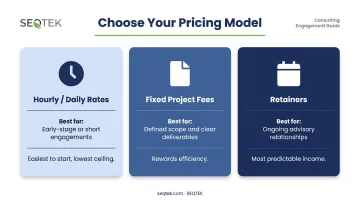
As expertise grows and your track record builds, so does your pricing power. The BLS median for employed management analysts was $101,190 in 2024 — but that figure explicitly excludes self-employed consultants, whose earnings vary widely based on niche, pricing model, and volume of engagements.
Sign 6: You've Experienced a Career Disruption
Layoffs, restructurings, and voluntary departures often accelerate the consulting decision — not because consulting is a fallback, but because disruption removes inertia. U.S. employers announced 761,358 job cuts in 2024, up 5.5% from the prior year, spanning technology, manufacturing, automotive, and healthcare.
The reframe worth considering: a job search and a consulting launch share more in common than most people realize.
- Update your profile — the same positioning work applies to both
- Activate your network — your contacts become potential clients, not just references
- Articulate your value — the core message you'd pitch to employers works equally well for clients
Disruption is uncomfortable. It's also one of the few events that clears the runway to ask what you actually want next — and act on it.
Sign 7: You Have the Itch to Build Something of Your Own
Many experienced professionals reach a point where they want to own something — a reputation built independently, work that reflects personal purpose rather than someone else's organizational vision.
Independent consulting is one of the lower-risk paths to that goal:
- Your expertise is the product — no inventory, no manufacturing, no distribution
- Startup costs are minimal — primarily your time, a professional presence, and basic business infrastructure
- You can start while still employed — test your positioning and niche before committing fully
The entrepreneurial pull is real. And for professionals with deep domain expertise, consulting is often the cleanest way to act on it without betting everything at once.
Are You Ready to Make the Leap?
Before going independent, ask yourself four honest questions:
- Do you have a financial runway? Fidelity recommends 3–6 months of essential expenses as a personal emergency fund — that's a reasonable minimum before you stop receiving a salary.
- Is your expertise specific enough to sell? Can you describe, in one sentence, the exact type of problem you solve for a specific type of organization?
- Are you prepared to run a business? Sales, marketing, contracts, invoicing, and client relationships don't manage themselves alongside your actual consulting work.
- Do you have relationships to start from? Your first clients almost always come from your existing network — not from cold outreach or a new website.
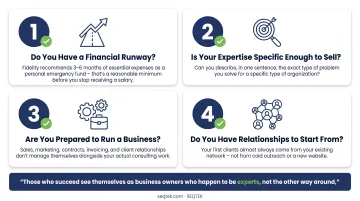
The mindset shift matters more than any skill set. Independent consulting means running a small business — and those who succeed see themselves as business owners who happen to be experts, not the other way around.
Going independent means exchanging structure and stability for autonomy and upside. What you're willing to manage day-to-day matters as much as what you know how to do.
Tips to Start Your Independent Consulting Journey
Narrow Your Niche Before You Launch
The most effective independent consultants are known for solving a specific problem for a specific type of organization. Vague positioning leads to difficult sales conversations and pricing pressure. "I help mid-size manufacturers reduce ERP implementation failure rates" is more sellable than "I consult on technology and operations."
Build Visibility Around the Problem You Solve
Start by reframing your LinkedIn profile around the problem you solve rather than a list of job titles. Document past outcomes in terms of business impact — revenue recovered, timelines shortened, failure rates reduced — not activities. Write or speak publicly in your area of expertise.
The 2024 Edelman-LinkedIn B2B Thought Leadership Impact Report found that 75% of decision-makers said strong thought leadership prompted them to research a product or service they hadn't previously considered, and 86% said it would make them likely to invite an organization into an RFP process.
Start Conversations Before You Formalize Everything
Your first clients are already in your network. Reach out to former colleagues, clients, and managers with a specific message about the problem you now solve — before you have a website, a logo, or a registered business entity. The infrastructure can wait; the conversation cannot.
A few practical starting points:
- Message 5-10 former colleagues or clients with a specific, one-sentence description of what you now do independently
- Ask for a 20-minute call, not a pitch meeting — curiosity opens doors
- Follow up on past work: if you solved a problem for someone before, they already trust your ability to do it again
Frequently Asked Questions
What is an independent business consultant?
An independent business consultant is a self-employed professional who provides specialized expert advice to organizations on a contract basis. Unlike an employee, they work across multiple clients simultaneously, selling judgment and outcomes rather than executing assigned tasks.
How much do independent consultants get paid?
Income ranges widely (from supplemental part-time earnings to six or seven figures annually), depending on niche, pricing model, volume of engagements, and experience. Research current market rates for your specific field and specialization before setting your pricing.
How do independent consultants get paid?
The three common structures are hourly/daily rates, fixed project fees, and monthly retainers. Most experienced consultants move away from hourly billing toward project or value-based pricing as their track record and pricing confidence grow.
What is the difference between an independent consultant and a freelancer?
Freelancers typically execute defined tasks: writing, design, coding. Independent consultants advise on strategy and approach. Consultants are hired for their judgment and pattern recognition across similar problems, not their ability to produce a specific deliverable.
Do I need to quit my job before starting independent consulting?
Many consultants start part-time — taking on small projects during evenings or weekends — while still employed. This reduces financial risk and lets you validate demand before committing fully.