Most conversations about IBPA get stuck in theory: RPA, AI, machine learning, layered acronyms that sound impressive but say little. The real story shows up on the ground floor, in fewer processing errors, faster cycle times, and decisions made with better information.
This article breaks down what IBPA actually is, the measurable advantages it delivers, and how to extract real value from it, not just adopt it and hope.
TL;DR
- IBPA combines RPA, AI, and ML to automate and improve complex workflows—not just repetitive tasks
- Lower costs, higher accuracy, faster decisions, and stronger customer and employee experience
- Compounding returns come from treating IBPA as an ongoing practice, not a one-off project
- Success requires the right mix of technology, process redesign, and change management
What Is Intelligent Business Process Automation?
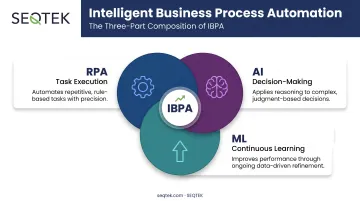
Intelligent business process automation (IBPA) blends three components:
- RPA handles task execution: data entry, transactions, repetitive steps
- AI adds decision-making: classification, anomaly detection, judgment calls on exceptions
- ML enables continuous learning, so the system improves as it processes more data
You'll find IBPA at work across finance, HR, procurement, customer service, and supply chain, anywhere high-volume, decision-heavy workflows create bottlenecks. Gartner frames intelligent automation as workflow automation combined with advanced analytics and AI/ML, including a feedback loop that supports ongoing process improvement.
Speed, accuracy, and scalability are the outcomes that matter. IBPA is how teams get there.
Key Advantages of Intelligent Business Process Automation
These advantages map directly to what leadership already tracks: cost, efficiency, quality, risk, and growth. The value multiplies when you pursue them together rather than optimizing for one metric and stopping there.
Advantage 1: Significant Cost Reduction and Labor Efficiency
IBPA reduces manual labor hours on two fronts: rule-based tasks handled by bots, and decision-heavy steps handled by AI layers for exceptions. Instead of scaling headcount linearly with transaction volume, you scale automation capacity instead.
What the numbers show:
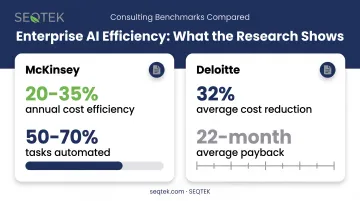
- McKinsey: 20%–35% annual run-rate cost efficiencies by automating 50%–70% of tasks
- Deloitte (479 executives, 35 countries): 32% average cost reduction once past pilot—though average payback was 22 months, not the six-month timelines some vendors promise
KPIs impacted: operating costs, cost-per-transaction, FTE hours saved.
This advantage matters most in high-volume, repetitive workflows — think seasonal spikes in claims processing or unpredictable surges in order volume, where hiring temporary staff no longer makes financial sense.
Advantage 2: Improved Accuracy and Reduced Risk
Manual, data-heavy processes are error factories. IBPA cuts human error through AI-driven validation that flags anomalies before they turn into costly mistakes.
The financial stakes are real. IBM reports more than a quarter of organizations estimate annual losses above $5 million from poor data quality, with 7% reporting losses of $25 million or more.
That figure covers inaccurate, incomplete, and inconsistent data broadly—not manual entry error alone—but the point holds: data quality problems are expensive.
Why this matters for compliance:
- Consistent, rules-based execution improves audit readiness
- Deloitte notes RPA and cognitive intelligence in audit contexts can run tasks more than 90% faster than manual work, supporting full-population testing instead of small samples
- Fewer errors upstream means less rework and fewer downstream corrections
KPIs impacted: error rates, compliance incidents, rework hours.
This advantage carries the most weight in highly regulated industries — banking, healthcare, oil and gas — where compliance failures aren't just embarrassing. They're expensive, sometimes catastrophic.
Advantage 3: Faster, Data-Driven Decision-Making
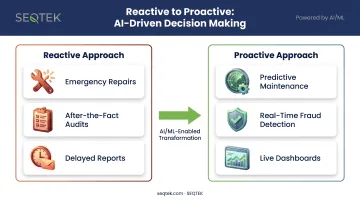
AI/ML components analyze data in real time and surface patterns that would take a human analyst hours or days to spot. That shifts decision-making from reactive firefighting to proactive management. Teams move toward predictive maintenance instead of emergency repairs, and fraud detection instead of after-the-fact audits.
Real-world cases back this up:
- Deutsche Bank's GenAI implementation processes thousands of documents daily at 97% accuracy with 40% lower handling time
- Insurtech company Loadsure cut claims verification from 30-60 minutes down to near real time using AI-powered extraction and verification
Faster decisions translate directly to competitive advantage. Leadership acting on real-time insight beats leadership waiting on last month's lagging report every time.
KPIs impacted: decision cycle time, forecast accuracy, time-to-resolution.
This benefit matters most in complex, high-stakes environments — manufacturing production planning, financial risk assessment — where a delayed decision costs more than a wrong one made quickly and corrected.
Advantage 4: Enhanced Customer and Employee Experience
IBPA improves service on both sides of the equation. Chatbots, faster approvals, and self-service tools speed up customer-facing responsiveness. Meanwhile, removing tedious repetitive work from employees' plates tends to boost engagement.
The stakes on the customer side are steep. PwC's 2025 US survey found 52% of consumers stopped buying from a brand after a bad product or service experience, and 29% left after poor customer experience specifically.
On the employee side, Deloitte reports 70% of workers re-enter data across multiple systems. That is pure friction with zero value-add. Organizations with stronger workforce experiences saw 22% higher engagement, and those employees were four times more likely to stay.
KPIs impacted: customer satisfaction scores, employee turnover, response times.
This advantage hits hardest in customer-facing industries — airlines, healthcare, financial services — where experience is the retention lever, not an afterthought.
What Happens When IBPA Is Missing or Ignored
Delay automation adoption long enough, and the consequences compound:
- Inconsistent outcomes when teams and locations handle the same work differently
- Higher error rates and compliance exposure from manual handling that no one has time to double-check
- Reactive firefighting in place of proactive process management
- Rising operational costs as transaction volume outpaces manual processing capacity
- Difficulty scaling without adding headcount at the same rate as growth
None of these show up overnight. They creep in, quarter after quarter, until someone asks why costs are climbing faster than revenue.
How to Get the Most Value from Intelligent Business Process Automation
IBPA pays off when it's implemented with strategy and support behind it, not just software licenses. A few principles separate the organizations that see compounding returns from the ones stuck running stalled pilots forever.
Redesign the process before you automate it. Automating a broken workflow just makes the broken workflow run faster. SEQTEK's approach follows a five-phase framework built on Lean and continuous-improvement principles:
- Diagnose
- Design
- Simplify & Optimize
- Enable & Empower
- Sustain
The optimization phase strips out waste and redundancy before anything gets automated.
Monitor and iterate, don't set and forget. High performers treat automation as a living system that gets tuned as data quality improves and business needs shift. Pilots that stall usually stall because nobody kept adjusting them.
Bring in expertise if you don't have it in-house. Organizations without dedicated automation teams often move faster and with less risk by partnering with a firm that's done this before.
SEQTEK has guided technology transformation for 25+ years across manufacturing, healthcare, and financial services. Its Localshoring® model keeps delivery teams closely integrated with client teams, which reduces the communication friction and adoption resistance that typically derail automation rollouts.

Conclusion
The real value of IBPA comes when cost savings, accuracy, speed, and better experience work together. Pursue them individually and you'll get incremental gains. Pursue them as a combined strategy and the advantages compound as your processes mature and your data quality improves.
Treat IBPA as a capability you build over time, not a project you finish and walk away from.
Frequently Asked Questions
What is intelligent business process automation?
IBPA combines RPA, AI, and machine learning to automate and continuously improve complex business workflows. Unlike basic automation, it handles decision-heavy steps and learns from ongoing data, not just fixed rule execution.
What types of tools power intelligent automation?
Common categories include RPA task-execution platforms, workflow orchestration tools, document/data extraction software, and AI/ML decision engines. The right combination depends on your existing systems and process complexity.
What is an example of intelligent business process automation?
Automated invoice processing is a common example: OCR captures the document data, AI validates it against business rules, and exceptions get routed to a human for review instead of stalling the entire process.
How is intelligent automation different from basic automation?
Basic automation follows fixed, rule-based scripts with no adaptability. IBPA adds AI and ML layers that learn, handle variability, and make judgment calls on exceptions rather than breaking down when inputs don't match the script.
What industries benefit most from intelligent business process automation?
High-volume, compliance-heavy industries see the biggest impact — banking, healthcare, manufacturing, and oil and gas. These sectors combine large transaction volumes with strict regulatory requirements, where errors carry real financial and legal costs.
How long does it take to see ROI from intelligent automation?
Timelines vary by process complexity. Deloitte reported an average pilot payback of about 22 months, while well-scoped narrow pilots can return value in under six months—expect a range, not a guarantee.