That shift creates real pressure. Choosing the wrong data science partner doesn't just waste budget, it slows decision-making, introduces compliance risk, and leaves revenue on the table. In regulated, high-stakes industries like banking, healthcare, and oil & gas, the margin for error is thin.
This guide ranks the top data science companies serving the US market in 2026, from global cloud platforms to specialized consulting partners. We'll break down what each one does well, who they're built for, and how to evaluate them based on business outcomes rather than brand size alone.
Key Takeaways
- Data science employment and investment keep climbing in 2026, easily outpacing the broader job market
- Top providers span everything from global cloud giants to specialized consulting boutiques
- Fit matters more than fame: industry experience and delivery model determine results
- Localshoring is gaining ground over traditional offshore outsourcing for faster iteration
- This guide profiles nine leading firms and a practical framework for choosing among them
Overview of the Data Science Market in the USA
Data science blends statistics, machine learning, and domain expertise to turn raw, messy data into decisions a business can actually act on.
The US job market reflects how central this work has become. The Bureau of Labor Statistics counted 245,900 data scientist jobs in 2024 and projects 34% growth through 2034, adding roughly 82,500 new positions and about 23,400 openings every year. That's nearly ten times faster than the average occupation.
Behind those numbers sits a market split across three categories:
- Big data infrastructure providers: companies building the pipes, lakehouses, and cloud platforms data runs through
- Analytics software vendors: firms selling the tools that turn data into models, dashboards, and forecasts
- Full-service consulting and AI partners: teams that design strategy, build custom solutions, and manage change alongside the technology
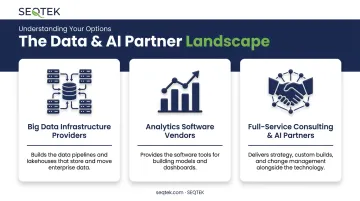
Most businesses need pieces of all three, not a single vendor doing everything. The list below spans each category, so you can compare options against what your organization actually needs.
Top Data Science Companies in the USA for 2026
This list blends large-scale cloud and AI platforms with specialized consulting partners, because the "best" company depends entirely on your size, industry, and how hands-on you need your partner to be. A Fortune 100 bank and a regional healthcare network don't need the same vendor. Match capability to your actual use case, not just the name on the logo.
SEQTEK
SEQTEK has operated as a strategic consulting and technology partner since 1999, working out of Tulsa, Oklahoma. The firm built its reputation on Localshoring, an onshore delivery model that embeds US-based teams directly inside client organizations rather than routing work through offshore contractor pools. Clients include General Electric, ABB, ONEOK, and Vetsource, spanning oil & gas, banking, healthcare, manufacturing, and airline sectors.
What sets SEQTEK apart is pairing strategic roadmapping with hands-on execution. Its teams build the data pipelines, ML models, and dashboards themselves, then stay through adoption.
The firm's AI readiness assessments score organizations across four dimensions: strategic, team, data, and technical, before implementation even starts. That structure, combined with ADKAR-based change management, shortens feedback cycles and improves the odds a new system actually gets used. The firm has delivered 500+ projects since its founding.
| Category | Details |
|---|---|
| Key Offerings | Data strategy consulting, AI/ML implementation, business intelligence, change management support |
| Delivery Model | Localshoring (onshore, embedded teams) vs. traditional offshore/nearshore outsourcing |
| Best Fit For | Mid-market and enterprise clients in oil & gas, banking, healthcare, manufacturing, and airlines seeking a long-term transformation partner |

Palantir Technologies
Palantir builds data integration and AI platforms for government agencies and large enterprises, with government contracts supplying more than half of its recent revenue. The company relocated its headquarters to Aventura, Florida, after years based in Denver.
Palantir's Foundry platform handles data management, analytics, and workflow development for organizations running mission-critical operations. Its AI Platform (AIP) connects large language models to enterprise data, letting teams build AI agents and automations under strict security controls, a fit for defense, energy, and financial regulation.
| Category | Details |
|---|---|
| Key Offerings | Data integration, Foundry platform, AI Platform (AIP) for agentic AI deployment |
| Industries Served | Government, defense, healthcare, finance, energy |
| Best Fit For | Large enterprises and public sector organizations needing mission-critical data operations |
Databricks
Databricks was founded in 2013 by the original creators of Apache Spark, along with the team behind Delta Lake and MLflow. Its Data Intelligence Platform uses an open lakehouse architecture, merging data warehousing and AI development into one environment instead of forcing teams to stitch multiple systems together.
That unification is the differentiator. Enterprises building fraud detection, risk models, or personalization engines develop and deploy them on the same platform storing their data, a step most competitors still require separately.
| Category | Details |
|---|---|
| Key Offerings | Data lakehouse, unified analytics, AI/ML model development and deployment |
| Industries Served | Technology, finance, media, retail |
| Best Fit For | Data-mature enterprises building custom AI/ML pipelines at scale |
IBM
IBM has been shaping enterprise data science longer than most competitors have existed. Its researchers invented the relational database model in 1970 and created SQL shortly after, standards still running under most enterprise systems today.
That history now feeds into watsonx, IBM's integrated data and AI platform for hybrid environments. Watsonx.governance adds auditable controls across data, models, and workflows, tracking lineage and mapping regulatory requirements automatically. For banks and hospitals that need to prove how an AI decision was made, that governance layer matters as much as the model itself.
| Category | Details |
|---|---|
| Key Offerings | watsonx platform, AI governance, enterprise analytics tools |
| Industries Served | Finance, healthcare, government, manufacturing |
| Best Fit For | Large regulated enterprises needing AI governance alongside deployment |
Microsoft
Microsoft's Azure cloud underpins analytics and machine learning workloads for a huge share of corporate America, and adoption keeps accelerating. Azure AI Foundry reported 80,000 customers, including 80% of the Fortune 500, as of its most recent earnings report.
Azure's raw capability tells only part of the story; deep AI integration inside tools employees already use matters just as much. Microsoft Fabric unifies data engineering and analytics, while Copilot embeds AI directly into Excel, Teams, and Outlook.
| Category | Details |
|---|---|
| Key Offerings | Azure cloud analytics, Microsoft Fabric, Copilot AI integration |
| Industries Served | Cross-industry, especially finance, retail, healthcare |
| Best Fit For | Enterprises already invested in the Microsoft ecosystem seeking integrated AI tools |
SAS Institute
SAS has sold analytics software since 1976, longer than most of its rivals have existed, and that longevity shows in how deeply regulated industries trust it. Banks use SAS for credit risk modeling and stress testing; compliance teams use it for anti-money laundering monitoring and sanctions screening.
Forrester named SAS a Leader in enterprise fraud management. For organizations that need analytics infrastructure examiners will actually approve, SAS remains a mature, safe choice.
| Category | Details |
|---|---|
| Key Offerings | Advanced analytics software, data management, risk and fraud analytics |
| Industries Served | Finance, healthcare, retail, government |
| Best Fit For | Enterprises needing mature, compliance-ready analytics infrastructure |
ZS Associates
ZS was founded in 1983 by Andy Zoltners and Prabha Sinha, and now runs more than 15,000 employees across 40-plus offices. Unlike broad consulting firms, ZS built its practice almost entirely around healthcare and life sciences.
Its ZAIDYN platform uses AI trained specifically on life-sciences data to recommend next-best actions for commercial and patient-facing teams. Combined with ZS's long history in sales force optimization, that focus gives the firm a grasp of pharmaceutical launch dynamics that generalist consultancies typically lack.
| Category | Details |
|---|---|
| Key Offerings | Healthcare analytics, sales optimization, AI-powered decision support |
| Industries Served | Healthcare, life sciences, pharmaceuticals |
| Best Fit For | Healthcare and life sciences organizations needing specialized analytics consulting |
Fractal Analytics
Fractal, founded in 2000, serves Fortune 500 enterprises from offices across the US and abroad. Its pitch is unusual for the industry: it pairs behavioral science with AI algorithms, arguing that a technically perfect model fails if it ignores how humans actually make decisions.
That behavioral lens shows up in Fractal's decision-science platforms and customer analytics work for retail, CPG, and financial services clients.
| Category | Details |
|---|---|
| Key Offerings | AI consulting, customer analytics, decision-science platforms |
| Industries Served | Retail, CPG, financial services, technology |
| Best Fit For | Large enterprises seeking a blend of behavioral science and AI-driven analytics |
Deloitte
Deloitte is one of the largest employers of data science and AI talent in the country, backed by more than 470,000 employees globally and over $70.5B in FY2025 revenue firmwide. That scale lets Deloitte cover strategy, governance, implementation, and ongoing managed analytics under one contract.
IDC named Deloitte a Leader in its 2025 MarketScape for Worldwide AI Services. Enterprises wanting a single firm managing strategy, build, and run tend to gravitate here, though that breadth comes with a price tag smaller organizations may find harder to justify.
| Category | Details |
|---|---|
| Key Offerings | Data strategy consulting, AI implementation, managed analytics services |
| Industries Served | Cross-industry, including finance, government, healthcare, manufacturing |
| Best Fit For | Large enterprises needing broad, multi-disciplinary consulting alongside data science delivery |
How We Chose the Best Data Science Companies
We evaluated each company using four factors, not marketing claims:
- Proven expertise — years in market, notable clients, and demonstrated project outcomes
- Technology and platform capability: whether the tools scale to enterprise data volumes and support current AI/ML needs
- Delivery model fit — onshore, offshore, nearshore, or Localshoring, and how that affects communication speed and adoption
- Industry-specific track record: whether the company understands the regulatory and operational realities of your sector
Skipping these factors is where most vendor selections go wrong. The most common mistake businesses make is picking a provider based on brand recognition or the lowest hourly rate. Months later, they discover the delivery model doesn't fit how their internal teams actually work. A recognizable logo doesn't guarantee a shorter feedback loop or better user adoption.
How to Choose the Right Data Science Partner for Your Business
Start with your own data maturity, not the vendor list. A Fortune 500 platform built for petabyte-scale operations is overkill if your organization is still cleaning up spreadsheets and disconnected systems. Define your business goals and current data readiness first, then compare providers against that baseline.
From there, weigh the trade-offs:
- Large SaaS and consulting giants offer breadth, brand recognition, and the ability to handle massive scale, but often move slower and require more internal management overhead
- Specialized or localshored partners offer speed, closer collaboration, and delivery tailored to your context, though they may cover a narrower range of services
- Boutique or niche specialists bring deep expertise in a specific industry or technology stack, but rarely extend into broader organizational change management
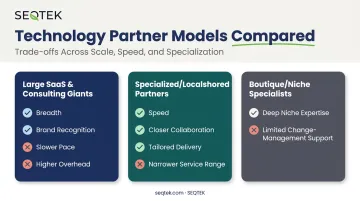
These trade-offs play out differently across industries. Sectors with heavy regulation or operational complexity, such as oil & gas, banking, healthcare, and airlines, tend to benefit most from partners who combine technical depth with hands-on change management. Technology alone rarely delivers results if the people using it never adopt it, and that resistance is why so many change initiatives fail.
SEQTEK's Localshoring model is a practical example of this trade-off. Instead of routing work through an offshore team with a 12-hour time difference, SEQTEK embeds onshore US-based professionals directly with client teams.
That structure shortens feedback cycles, keeps stakeholders in the loop in real time, and improves internal adoption compared to conventional offshore engagements. For a mid-market manufacturer or regional bank weighing a mega-vendor against a closer partnership, that difference in cadence often decides the outcome.
Conclusion
The "best" data science company isn't a fixed answer. It depends on matching technical capability to your industry, scale, and how closely you want a partner working alongside your team. A global bank running fraud models at scale needs something different than a regional healthcare network modernizing its first data warehouse.
Evaluate potential partners on scalability, cultural fit, and long-term outcomes, not just the number on the invoice. The cheapest option often costs more once slow iteration and low adoption enter the picture.
If you're weighing whether a Localshoring model fits your organization better than an offshore contract or a mega-vendor engagement, SEQTEK can help. The company has spent more than 25 years helping organizations in oil & gas, banking, healthcare, manufacturing, and aviation build data and AI systems that actually get used.
Contact SEQTEK at 918-493-7200 or contact@seqtek.com to talk through your next project.
Frequently Asked Questions
What are the 4 types of data science?
Data science breaks down into four core types: descriptive analytics (what happened), diagnostic analytics (why it happened), predictive analytics (what's likely to happen next), and prescriptive analytics (what action to take).
What companies are using data science?
Nearly every sector runs on data science now, including finance, healthcare, retail, manufacturing, and government. Companies like Databricks, IBM, Microsoft, and SEQTEK serve these industries directly, building the platforms and custom solutions behind daily decisions.
How much do data science companies charge in the USA?
US-based analytics consultants typically charge $100 to $250 per hour, with most projects landing between $10,000 and $49,999. Enterprise platform costs vary far more widely depending on scale and customization.
What industries rely most on data science?
Banking, healthcare, manufacturing, and energy show some of the heaviest adoption, driven by fraud detection, smart manufacturing, and clinical decision support. These align closely with SEQTEK's core industries: banking, oil & gas, healthcare, and manufacturing.
How do I choose the right data science company for my business?
Look for proven industry expertise, a delivery model that matches how your team works, real technology capability, and documented outcomes, not just brand recognition. Define your own data maturity before comparing vendors.
Is data science still in demand in 2026?
Yes. The BLS projects 34% employment growth for data scientists through 2034, far outpacing the 3% average across all occupations, with enterprise AI investment continuing to climb.