Introduction
Picture a finance team closing month-end books on a server that's been running since 2015. Reports that should take minutes take hours.
IT can't add capacity fast enough during peak season, and every new compliance requirement means another manual workaround.
This scenario plays out across industries every day. Legacy systems weren't built for today's data volumes, security demands, or scaling needs.
Organizations face a real dilemma: security risks multiply as scalability hits a ceiling, and choosing between public, private, or hybrid cloud feels like guessing.
Hybrid cloud is now the default approach, with 73% of organizations using it, according to Flexera's 2024 State of the Cloud Report. Getting there without overspending or stalling out requires more than good intentions.
This guide breaks down what cloud infrastructure development actually involves, the deployment models available, a realistic development process, and how to pick a partner who won't leave you stuck mid-migration.
Key Takeaways
- Cloud infrastructure development delivers the servers, storage, networking, and security behind scalable computing
- Private, public, and hybrid models solve different compliance, cost, and control needs
- A structured process (assess, design, migrate, optimize) reduces risk versus ad hoc rollouts
- Talent gaps and cost overruns are common, but the right partner and governance keep them in check
What Is Cloud Infrastructure Development?
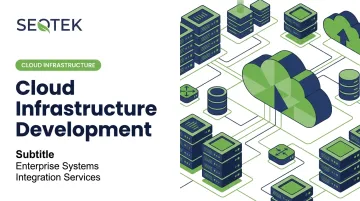
Cloud infrastructure development is the active process of designing, building, and managing the hardware and software foundation that runs your cloud environment. That includes servers, storage systems, networking, and virtualization layers working together.
It's easy to confuse this with two related terms:
- Cloud infrastructure refers to the actual physical and virtual resources themselves — the servers, storage, and network components in place at any given moment.
- Cloud architecture is the blueprint. It's the design strategy that decides how those resources should be arranged to meet business goals.
Cloud infrastructure development is the execution: taking that blueprint and turning it into a working, evolving environment. Think of architecture as the floor plan and infrastructure development as the construction crew that builds it, then keeps renovating as your business changes.
Core Components Businesses Must Develop
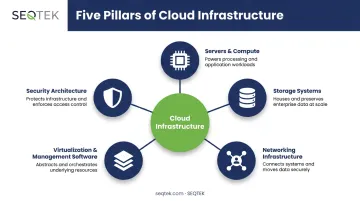
Every cloud environment rests on five foundational pieces. Get any one of them wrong, and performance or security suffers.
Servers and compute. Organizations must choose between virtual machines, bare-metal servers, and containers depending on workload type. Virtual machines include a full guest operating system and offer strong isolation. Containers share the host's kernel, making them lighter and faster to deploy for applications built to scale horizontally.
Storage systems. Different data needs call for different storage types:
- Object storage for unstructured data like backups, media files, and logs
- Block storage for high-performance applications like databases
- File storage for shared access across teams and applications
Networking infrastructure. Routers, load balancers, and virtual networks connect distributed resources and keep latency low. Without properly designed networking, even the best compute and storage setup will bottleneck under real-world traffic.
Virtualization and management software. Virtualization abstracts physical hardware into digital resources that teams can provision through dashboards rather than racking new servers. This is what makes elastic scaling possible.
Security architecture. Identity access management, encryption, and continuous monitoring need to be built in from day one. Retrofitting security after deployment almost always leaves gaps that attackers find first.
Types of Cloud Infrastructure Deployment Models
Organizations building cloud infrastructure choose from three primary models, each with different trade-offs around control, cost, and compliance.
Private Cloud
Private cloud infrastructure is dedicated entirely to a single organization. That exclusivity gives maximum control over data, security policy, and performance, which explains why heavily regulated industries lean on it.
- Healthcare organizations use private cloud to protect patient data under HIPAA
- Financial services firms use it to meet strict data residency and audit requirements
- Oil and gas companies rely on it for operational technology systems that can't tolerate shared-tenant risk
The trade-off is cost. Organizations carry more of the operating burden themselves, without the pooled economics public providers offer.
Public Cloud
Public cloud runs on a multi-tenant, pay-as-you-go model through providers like AWS, Azure, or Google Cloud. Organizations share underlying infrastructure with other customers, paying only for what they consume.
This suits organizations with variable workloads. Retail companies scaling for holiday traffic, or software teams testing new features, benefit from spinning resources up and down without capital outlay. Provisioning new capacity takes minutes instead of the weeks typically required for on-premises hardware procurement.
Hybrid Cloud
Hybrid infrastructure blends private and public environments. Sensitive workloads (patient records, financial transactions, proprietary manufacturing data) stay in a controlled private environment. Less-sensitive workloads move to public cloud, where elastic pricing keeps costs down.
This is why hybrid has become the majority approach. 73% of enterprises now run hybrid environments, and IDC found 88% of surveyed cloud buyers were deploying or operating hybrid cloud by late 2024. Rather than an either/or decision, hybrid cloud functions as a placement strategy, with teams routing each workload based on sensitivity and cost.
The Cloud Infrastructure Development Process
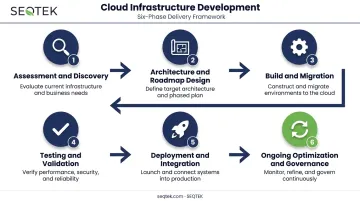
Cloud infrastructure development unfolds as a sequence of phases, each building on the last.
Assessment and discovery. Start by auditing existing systems, defining business goals, and identifying compliance and security requirements. Skipping this step is the single biggest predictor of scope creep later.
Architecture and roadmap design. Architects translate business requirements into a technical blueprint. This includes capacity planning, technology stack selection, and defining how workloads will be placed across private, public, or hybrid environments.
Build and migration. Teams provision servers, storage, and networking, then migrate workloads using strategies like re-platforming (minor adjustments) or refactoring (rebuilding for cloud-native performance).
Testing and validation. Load testing, security testing, and disaster recovery validation happen before go-live, not after. This catches failure points while they're still cheap to fix.
Deployment and integration. New infrastructure rolls out and connects with existing internal systems and teams. Adoption depends heavily on how well this integration is managed.
Ongoing optimization and governance. Performance monitoring, cost control, and resource adjustments continue well past launch to sustain ROI.
Skipping steps carries a real cost. McKinsey found that enterprise cloud migrations run 14% over budget on average, with 75% of enterprises behind schedule and 38% delayed by more than a full quarter. Only 15% hit both time and budget targets on more than 60% of their hosting spend.
The organizations that avoided this pattern shared three traits:
- Active executive sponsorship throughout the engagement
- An end-to-end roadmap built before migration started
- Dedicated DevOps and FinOps skills on the team
That structure separates predictable delivery from budget surprises.
Benefits of Strategic Cloud Infrastructure Development
Done right, cloud infrastructure development pays off in ways that compound over time.
Scalability on demand. Resources scale up or down instantly to match real demand, without large upfront capital investment. A seasonal spike in traffic no longer means a frantic hardware order.
Cost optimization. Infrastructure shifts from capital expenditure to operating expenditure. Instead of buying servers you might need in three years, you pay for what you actually consume today.
Improved agility and resilience. Well-built infrastructure supports faster application deployment cycles and stronger disaster recovery. Nearly half of organizations (49%) now use cross-cloud failover to keep critical systems running through outages.
One financial services firm, Lincoln Financial Group, migrated 120 systems and 100 million lines of code in under two years. McKinsey reports cycle-time improvements of 20% to 30% in the target state as a result. That's a single case, not a universal benchmark, but it illustrates what's achievable with disciplined execution.
Common Challenges in Cloud Infrastructure Development
Even well-planned cloud projects hit friction. Knowing where it shows up helps you plan around it.
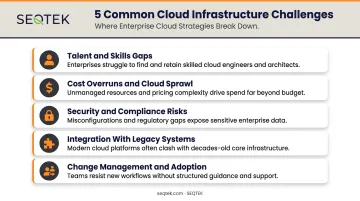
Talent and Skills Gaps
Most organizations don't have architects and engineers on staff with the specialized experience needed to design secure, scalable infrastructure. Hiring full-time for a project-based need rarely makes financial sense.
This is where a strategic partner earns its keep. SEQTEK's Localshoring model, for example, provides access to architects, engineers, and analysts embedded directly with your team, without the communication delays and time-zone friction that come with offshore arrangements.
Cost Overruns and Cloud Sprawl
Beyond staffing, cost control presents another common hurdle. Poor governance and lack of monitoring let costs spiral fast. 84% of organizations struggle to manage cloud spend, and Flexera's cloud spend report estimates nearly 29% of that spend is wasted on over-provisioned or unused resources.
Security and Compliance Risks
Security introduces further risk once workloads move to the cloud. Migrating sensitive workloads without proper planning invites data breaches and regulatory violations. Research covered by CIO found compliance violations at 48% of organizations tied to cloud security gaps, and misconfigurations caused operational downtime at 45%.
Integration With Legacy Systems
Legacy systems compound these challenges further. Connecting new cloud environments to existing on-premises applications and data is rarely simple. Old systems weren't designed with APIs or modern connectivity in mind, and forcing that connection without careful design creates fragile integrations that break under load.
Change Management and Adoption
Technical success alone doesn't guarantee results. Even flawless infrastructure fails if employees resist using it. Training gaps and unclear communication undermine adoption, turning a technically sound migration into an operational headache.
Choosing the Right Cloud Infrastructure Development Partner
Picking a partner is where most of the risk in this process gets decided. A few criteria matter more than the rest.
- Industry experience. The partner has worked in your regulatory environment (healthcare, banking, energy) and understands its specific constraints.
- Proven track record. Ask for examples of completed projects, not just capability slides.
- Security expertise. Confirm they build identity management, encryption, and monitoring into the design phase, not as an afterthought.
- Strategic guidance plus hands-on execution. Some firms sell infrastructure and walk away. Others stay through implementation and beyond.
The strongest partners combine an unbiased assessment of your current state with specialized talent across architecture, engineering, and change management, rather than pushing a predetermined product.
SEQTEK has operated this way since 1999, delivering 500-plus projects across aviation, oil and gas, banking, healthcare, and manufacturing.
The Localshoring model keeps teams embedded with clients instead of working remotely across time zones. This shortens feedback cycles and keeps knowledge transfer flowing back into your organization, rather than staying locked with an outside vendor.
That combination of strategy and execution turns a cloud infrastructure project into a lasting capability, not just a one-time build.
Frequently Asked Questions
What is cloud infrastructure?
Cloud infrastructure is the combined hardware and software, including servers, storage, networking, and virtualization, that powers cloud computing. It's the physical and virtual resource layer your applications and data run on.
What are the different types of cloud infrastructure?
The three primary models are private (dedicated to one organization), public (shared, pay-as-you-go), and hybrid (a blend of both). Most enterprises now run hybrid environments to balance control and cost.
What is the difference between cloud infrastructure and cloud architecture?
Cloud architecture is the design blueprint, deciding how resources should be arranged to meet business goals. Cloud infrastructure is the actual built environment, meaning the actual servers, networks, and systems running day to day.
How long does cloud infrastructure development typically take?
Timelines vary widely based on scope, workload complexity, and compliance needs. Projects typically move through assessment, design, migration, testing, and deployment phases, with larger or highly regulated environments taking longer.
What skills or roles are needed for cloud infrastructure development?
Successful projects typically need cloud architects, systems engineers, security specialists, and DevOps or FinOps talent. Few organizations keep all of these on staff full-time, which is why many partner with a firm like SEQTEK to fill the gaps.
How much does cloud infrastructure development cost?
Costs depend heavily on scale, deployment model, and workload complexity. A phased approach with an experienced partner like SEQTEK helps control spend and avoid the budget overruns common in unplanned migrations.