Introduction
Change never really stops. New technology rolls out, leadership shifts, mergers reshape org charts, and processes get rebuilt overnight. Each of these moments puts your change management strategy to the test.
Pick the wrong approach and you get resistance, wasted budget, and a rollout that reverts to "the old way" within months. Pick the right one, and adoption happens faster, with less friction and fewer surprises.
This guide breaks down what a change management strategy actually means, the main types organizations rely on, and how to match the right approach to your specific situation.
Key Takeaways
- Change management strategy is the deliberate approach leaders use to guide people through transition
- Three core strategies exist: Directive, Participative, and Negotiated, matched to urgency and employee involvement
- The best choice depends on culture, scope, and timeline, not leadership's comfort level
- Blending strategies across phases often outperforms rigidly sticking to one approach
What Is a Change Management Strategy and Why Does It Matter?
A change management strategy is a structured plan for how leadership will introduce, communicate, and embed a change across people, processes, and systems. It answers the big-picture question: how much control does leadership retain, and how much say do employees get?
This differs from a change management model: a strategy is the overall philosophy, while a model, such as ADKAR or Kotter's eight steps, is the execution tool used to carry that philosophy out. You choose your strategy first, then select the framework that helps you deliver it.
Why a Defined Strategy Matters
The numbers back this up. McKinsey's 2021 research on 1,034 transformation leaders found that fewer than one-third of transformations both improved performance and sustained that improvement. Successful transformations captured 67% of their maximum potential financial benefit. Unsuccessful ones captured just 37%.
Without a defined strategy, a few things reliably go wrong:
- Inconsistent messaging: different leaders explain the "why" differently, and confusion spreads
- Resistance builds quietly: employees fill information gaps with worst-case assumptions
- Old habits return: once initial momentum fades, teams slide back to familiar routines
A strategy is what separates change that sticks from change that fizzles out within three months, turning intention into lasting adoption.
Types of Change Management Strategies
Change management isn't one-size-fits-all. Organizations choose an approach based on how much control leadership needs to retain, how much employee input the situation demands, and how urgent the change actually is.
Many successful initiatives don't stick to a single lane. It's common to open with a Directive announcement, then shift into Participative refinement once the framework is in place. Here's how each type works.
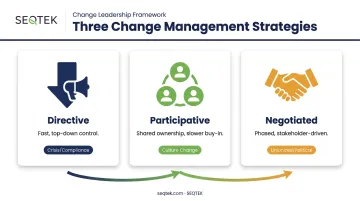
Directive (Top-Down) Strategy
What it is: Leadership defines the change and mandates implementation with limited employee input. How it works: Decisions get made at the top, communicated clearly, and enforced through policy, deadlines, or authority.
The core distinguishing factor here is speed and control. Leadership drives the change rather than co-creating it with staff.
Best suited for:
- Crisis response, regulatory or compliance mandates, and mergers
- Situations requiring fast, unambiguous action
- Hierarchical cultures or organizations with leaders who already carry strong trust and authority
Key strengths:
- Fast decision-making and implementation
- Consistent messaging across the organization
- Clear accountability from day one
Limitations: Input is minimal, so resistance and disengagement risk runs higher. Overusing this strategy for changes that don't actually require urgency damages the trust leadership needs later.
Participative (Collaborative) Strategy
What it is: Employees actively help shape, test, and refine the change before and during rollout. How it works: Leadership gathers feedback through workshops, pilot groups, or surveys, then adjusts the plan based on that input.
Shared ownership sets this approach apart from the other two. Decisions are co-created, not dictated from the top.
Best suited for:
- Culture change, process redesign, or technology adoption requiring long-term buy-in
- Flatter organizational structures with a strong employee-engagement focus
- Multi-department initiatives where frontline expertise shapes feasibility
Key strengths:
- Higher adoption rates and lower resistance since employees feel invested in the outcome
- Frontline feedback surfaces practical problems before they derail the rollout
- Stronger long-term culture alignment as employees see their input reflected in outcomes
In one aviation engagement, SEQTEK facilitated alignment sessions across flight operations, ground operations, safety, and IT leadership, unifying priorities and building a shared operational vision before any system changes went live. That kind of cross-functional input is what separates Participative work from a top-down memo.
Limitations: Consultation and consensus-building take time. Too many competing opinions can dilute the plan or stall it entirely.
Negotiated (Incremental) Strategy
What it is: Change gets introduced in phases through negotiation and compromise between leadership and affected groups, such as unions, departments, or key stakeholders. How it works: Leaders and stakeholder representatives agree on terms, pacing, and trade-offs before each phase proceeds.
What sets this approach apart is the formal negotiation process paired with a phased rollout, balancing control and collaboration rather than defaulting to either extreme.
Best suited for:
- Unionized environments, cross-functional restructuring, or politically sensitive changes touching compensation, roles, or job security
- Situations where stakeholder groups hold real leverage or contractual rights
- Multi-phase rollouts where early missteps carry high political or financial cost
Key strengths:
- Reduces conflict and legal or labor risk by formalizing agreements upfront
- Builds trust through transparency and mutual concessions
- Creates clear documentation that protects both leadership and stakeholders long-term
Limitations: This is often the slowest strategy of the three, given negotiation cycles and staged rollout. It also demands skilled facilitation. Without it, negotiations stall or produce watered-down outcomes that satisfy no one.
How to Choose the Right Change Management Strategy
The right strategy depends on your organization's specific needs, culture, and constraints, not on which approach is trending or most familiar to leadership.
Factors to Consider
- Purpose and urgency: Crisis-driven changes lean Directive. Culture shifts lean Participative.
- Scale and complexity: Enterprise-wide transformations often need a blended approach across different phases or departments.
- Culture and trust levels: Hierarchical cultures may accept top-down mandates without friction. Collaborative cultures often won't.
- Stakeholder leverage: Unionized or contractually protected groups may require a Negotiated approach, regardless of what leadership prefers.
- Budget, timeline, and internal capacity: Participative and Negotiated strategies demand more time and facilitation resources than most internal teams have available.
That last point trips up a lot of organizations. Facilitating workshops, running structured feedback loops, and managing negotiation cycles takes bandwidth most internal teams simply don't have on top of their regular workload.
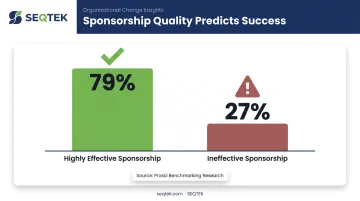
This is where bringing in an experienced change management partner makes a measurable difference, especially in keeping sponsors visibly engaged throughout the initiative. Executive sponsorship quality alone is a strong predictor of outcomes. Prosci's benchmarking research found initiatives with highly effective sponsors were 79% likely to meet objectives, compared to just 27% for those with ineffective sponsorship.
That's the gap SEQTEK helps close. The firm works with organizations across aviation, energy, banking, and healthcare to design and execute the right strategy for complex technology and process transformations. If your team is stretched thin on facilitation or negotiation capacity, that's worth a conversation.
Common Mistakes to Avoid When Choosing a Strategy
Even well-intentioned change efforts stumble when the strategy doesn't match the situation. Watch for these:
- Defaulting to Directive out of habit, even when the change needs long-term cultural buy-in that only Participative input can build
- Underestimating the time and facilitation skill Participative or Negotiated strategies demand, which stalls initiatives before they gain traction
- Ignoring trade-offs, such as choosing Participative for a time-sensitive compliance deadline that simply can't wait for consensus
- Choosing comfort over fit, selecting the strategy leadership is most familiar with instead of what the situation and stakeholders actually require
Each of these mistakes traces back to the same root cause: treating strategy selection as a formality, not a decision that deserves real analysis.
Conclusion
A change management strategy is the foundation for how your organization navigates transitions in people, process, and technology. Directive, Participative, and Negotiated strategies each serve different needs, and the strongest initiatives often blend them across phases rather than locking into one approach from start to finish.
Choosing correctly takes an honest look at urgency, culture, stakeholder leverage, and available resources. Partnering with a change and transformation partner like SEQTEK, which has guided organizations through people, process, and technology shifts since 1999, can help you choose, adapt, and execute the right strategy with more clarity and less guesswork.
Frequently Asked Questions
What are the five effective change management strategies?
Common tactical practices include clear planning, transparent communication, structured training, phased rollout, and visible leadership sponsorship. These tactics support whichever broader strategy type, Directive, Participative, or Negotiated, you've chosen.
What are the 5 C's of change management?
There's no single standardized version, but a commonly referenced list includes Clarity, Communication, Commitment, Culture, and Change agents. These elements reinforce execution regardless of which core strategy you select.
What are the 7 R's of change management?
The 7 R's (Raised, Reason, Return, Risks, Resources, Responsibility, Relationship) originated in IT service change evaluation rather than organizational change management. They're useful for assessing individual change requests, not for choosing a broader people-side strategy.
What is the difference between change management and change leadership?
Change management refers to the processes, tools, and structures that keep a change effort orderly and controlled. Change leadership is the vision, urgency, and energy that drives larger transformation. Kotter argues both are needed for major change to succeed.
Which change management strategy works best for large, complex organizations?
Enterprise organizations often blend Directive and Participative approaches, using clear top-down direction to set scope and timeline while gathering input from department leaders. Negotiated strategies become necessary when multiple business units or external partners must align on the change.
How long does it take to implement a change management strategy?
Timelines vary widely by strategy and scope. McKinsey's transformation roadmap research outlines horizons from 3-12 months for early wins up to 24+ months for larger bets, while Negotiated changes often take longest due to negotiation cycles.