That question has gotten harder to answer. Tech giants are announcing multi-billion-dollar funding rounds seemingly every quarter, and startups are shipping model updates faster than most IT departments can evaluate them. Healthcare systems, banks, energy companies, and manufacturers are all racing to figure out who actually delivers results versus who just has the best marketing.
This guide breaks down the 10 AI companies defining 2026, what sets each apart, and how to think about choosing the right partner for your specific operation.
Key Takeaways
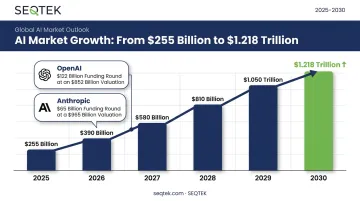
- AI market growth is explosive: $1.2 trillion by 2030, up from ~$255 billion in 2025
- The top 10 spans frontier model labs, cloud/hardware providers, and enterprise AI platforms
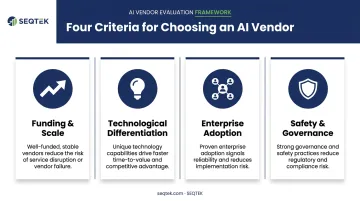
- Selection criteria—funding, differentiation, adoption, governance—matter more than brand name
- Vendor selection and implementation-partner selection are separate decisions
Overview of the AI Company Landscape in 2026
"Top AI company" means different things depending on who's asking. For this list, it covers three distinct categories:
- Frontier model labs building the large language models everyone else builds on top of
- Cloud and infrastructure providers supplying the compute and hosting layer
- Enterprise AI platforms that package models into usable business tools
Each of these categories is expanding at a pace few industries can match. Statista projects the global AI market will exceed $1.218 trillion by 2030, up from roughly $255 billion in 2025. That growth curve reflects an industry reshaping itself in real time.
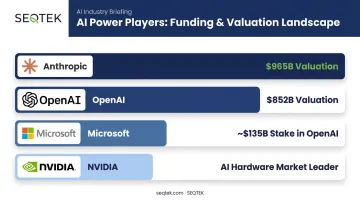
You can see the intensity in the deal-making. OpenAI closed a funding round in March 2026 with $122 billion in committed capital at an $852 billion post-money valuation, one of the largest private fundraises in history. Rounds like that aren't outliers anymore. They're becoming the norm at the top of this market.
The list below ranks the companies leading that race, based on innovation, scale, and how much enterprise trust they've actually earned rather than just claimed.
Top 10 Artificial Intelligence Companies in 2026
Rankings here weigh four factors: funding and scale, technological differentiation, enterprise adoption, and demonstrated trust from customers who've bet real budget on these platforms.
OpenAI
OpenAI, founded in 2015 in San Francisco, created ChatGPT and the GPT model family that kicked off the generative AI boom in the first place. Its flagship reasoning model, GPT-5.6 Sol, began rolling out in mid-2026, alongside agent tools like ChatGPT agent (which absorbed the earlier Operator browser-automation feature) and Deep Research for multi-step internet analysis.
OpenAI's scale of adoption, spanning consumer and enterprise users, remains unmatched. A March 2026 funding round pushed its valuation past $850 billion, making it the category's biggest player by capital and mindshare alike.
| Founded & HQ | 2015, San Francisco, California |
| Flagship Offering | GPT model family & ChatGPT |
| Best For | Enterprises needing general-purpose LLMs and AI agents |
Anthropic
Founded in 2021 by former OpenAI researchers, Anthropic built its Claude model family around a Constitutional AI framework, training models through self-critique against a written set of principles rather than relying solely on human feedback loops.
That safety-first approach has made Anthropic the default choice for regulated industries. Anthropic raised $65 billion in a Series H round in May 2026, reaching a $965 billion post-money valuation, reflecting how much enterprise demand exists for a model provider that treats governance as a feature, not an afterthought. Current offerings include Claude Opus 5, Sonnet 5, and Haiku 4.5.
| Founded & HQ | 2021, San Francisco, California |
| Flagship Offering | Claude assistant & developer API |
| Best For | Safety-conscious deployments in finance, defense, and healthcare |
Google (Gemini & DeepMind)
Google doesn't need an introduction, but its AI strategy does. The Gemini model family now spans multiple tiers, from lightweight Flash variants to the more capable Gemini 3 line, all deeply wired into Search, Workspace, and Google Cloud's Vertex AI platform.
What separates Google from pure model labs is integration depth. DeepMind's research into multimodal and world models feeds directly into products consumers and enterprises already use daily, giving Google a distribution advantage almost no competitor can match.
| Founded & HQ | 1998, Mountain View, California |
| Flagship Offering | Gemini models & Vertex AI |
| Best For | Enterprises wanting a full cloud-plus-AI ecosystem |
Microsoft
Microsoft embeds Copilot across the entire Microsoft 365 suite, while Microsoft Foundry (the platform previously known as Azure AI Studio) and Copilot Studio give enterprises tools to build and govern custom agents on top of Azure infrastructure.
The Microsoft-OpenAI relationship remains central here. Microsoft's investment in OpenAI Group PBC was valued at roughly $135 billion in late 2025, and the two companies restructured their partnership to preserve Azure API exclusivity while OpenAI committed to purchasing an additional $250 billion in Azure services. For companies already standardized on Microsoft's stack, that partnership makes adoption almost frictionless.
| Founded & HQ | 1975, Redmond, Washington |
| Flagship Offering | Copilot & Azure AI |
| Best For | Enterprises standardized on Microsoft 365/Azure |
NVIDIA
Nearly every company on this list runs on NVIDIA silicon at some point in its pipeline. NVIDIA designs the GPUs and AI computing systems that train and run these models, from Blackwell Ultra data center chips to Jetson modules powering robotics and autonomous vehicles at the edge.
Its next-generation Vera Rubin platform entered production in early 2026, with partner products expected in the second half of the year. That near-foundational role in AI hardware is why NVIDIA's earnings calls move markets far beyond the chip industry.
| Founded & HQ | 1993, Santa Clara, California |
| Flagship Offering | GPU accelerators & Jetson edge AI platforms |
| Best For | Organizations needing AI compute infrastructure at scale |
Meta
Meta consolidated its advanced AI work into Meta Superintelligence Labs in 2025, and it's the driving force behind the open-weight Llama model family, now embedded across Instagram, WhatsApp, and Meta's smart glasses hardware.
The current Llama 4 lineup includes Scout and Maverick, both natively multimodal mixture-of-experts models. Scout supports a 10-million-token context window, which is enormous by industry standards. Because Llama models are open-weight, enterprises can self-host them without the vendor lock-in that comes with closed API-only providers.
| Founded & HQ | 2004, Menlo Park, California |
| Flagship Offering | Llama open-weight model family |
| Best For | Enterprises wanting self-hosted, open-source AI models |
Amazon (AWS)
AWS built the cloud backbone that a huge share of AI adoption runs on. Amazon Bedrock lets businesses build chatbots, search tools, and agents using foundation models from Amazon and third-party providers, while SageMaker AI handles the full model training and deployment lifecycle.
Amazon's broadest-in-class cloud market share, paired with mature MLOps tooling built over more than a decade, makes AWS the practical default when a company needs production-grade AI at genuine scale rather than a proof of concept.
| Founded & HQ | 1994, Seattle, Washington |
| Flagship Offering | AWS Bedrock & SageMaker |
| Best For | Enterprises needing scalable, production-grade cloud AI |
xAI
Elon Musk founded xAI in 2023, and the company has moved fast since then. Grok, its flagship chatbot family, now spans reasoning, code, voice, and image/video capabilities, with Grok 4.5 serving as the current flagship model and grok-code-fast-1 handling economical agentic coding tasks.
xAI's edge is speed. Its models integrate real-time platform data in ways slower-moving competitors haven't matched, which makes it a natural fit for conversational AI use cases that depend on current information rather than a static training cutoff.
| Founded & HQ | 2023, Palo Alto, California |
| Flagship Offering | Grok |
| Best For | Businesses wanting real-time, conversational AI |
IBM
IBM has spent more than a century building enterprise trust, and its watsonx platform is built around that reputation. It covers model development (watsonx.ai), governed data access (watsonx.data), AI governance and risk management (watsonx.governance), and agent orchestration (watsonx Orchestrate).
For large enterprises running hybrid cloud environments with strict compliance requirements, IBM's emphasis on auditability makes it one of the few vendors purpose-built for legacy modernization in regulated sectors.
| Founded & HQ | 1911, Armonk, New York |
| Flagship Offering | watsonx platform |
| Best For | Regulated industries needing AI governance and hybrid deployment |
Palantir Technologies
Palantir's Artificial Intelligence Platform (AIP) connects third-party large language models to an organization's actual operational data, giving government agencies and commercial enterprises real-time decision-making tools built on data they already own.
Its mission-critical government contracts, combined with a deep operational data integration capability, give Palantir a niche few competitors can touch. The company reported U.S. commercial revenue growth exceeding 100% year over year in early 2026, a sign that its government-grade approach is translating into private-sector demand too.
| Founded & HQ | 2003, Aventura, Florida |
| Flagship Offering | Palantir AIP |
| Best For | Large enterprises and government agencies needing integrated data-driven AI decisioning |
How We Chose the Top AI Companies
Ranking AI companies is easy to get wrong if you're chasing headlines instead of fit. A lot of businesses default to whichever name shows up most in the news, then discover months into implementation that the platform doesn't actually match their compliance needs or existing tech stack.
We weighed four factors instead:
- Funding and scale: a signal of staying power and continued R&D investment
- Technological differentiation: what a company does that competitors genuinely can't replicate
- Enterprise adoption: real usage, not just press coverage
- Safety and governance record: critical for regulated industries where a compliance failure costs more than a bad software choice
Each of those ties to a business outcome. Strong governance reduces regulatory risk. Genuine differentiation speeds up time-to-value because you're not fighting the tool's limitations. Scale and adoption suggest the vendor will still be supported in three years.
Here's the part that gets overlooked most often: integration complexity and vendor lock-in should weigh as heavily as brand recognition. A well-known model provider that doesn't fit your existing data architecture can cost more in rework than a smaller, better-matched platform ever would.
This is exactly where an experienced, unbiased technology consulting partner earns its keep. Firms like SEQTEK evaluate vendors against your actual business goals rather than a sales pitch, which matters when the "best" model on paper isn't the best fit for your infrastructure.
Conclusion
There's no universal winner in this list. The right AI company for a regional bank managing SOX compliance looks nothing like the right choice for a manufacturer running edge AI on factory floors. Capability has to match your industry, your existing systems, and what you're actually trying to accomplish.
Keep assessing performance, integration fit, and cost-effectiveness even after you've selected a vendor. This market moves fast enough that today's right answer might need revisiting within a year. That kind of ongoing evaluation is easier with a partner who has already guided other organizations through it.
SEQTEK has spent more than 25 years helping organizations across aviation, oil and gas, banking, healthcare, and manufacturing move through exactly this kind of decision. Through its Localshoring model, SEQTEK works alongside client teams to evaluate, select, and implement the AI solutions that actually fit, not just the ones with the biggest marketing budget.
If you're weighing your options, reach out to SEQTEK for a second, unbiased opinion before you commit.
Frequently Asked Questions
What companies are developing artificial intelligence?
Development spans frontier model labs like OpenAI and Anthropic, cloud providers like AWS and Google, hardware makers like NVIDIA, and enterprise platform vendors like IBM and Palantir. Each plays a different role in the AI stack.
Which companies are leading the development of artificial intelligence?
OpenAI, Anthropic, Google, and Microsoft currently lead based on funding, adoption, and research output. Each has secured massive investment and holds significant enterprise and consumer market share.
Who are the "Big 7" companies developing artificial intelligence?
There's no standardized definition. The term usually points to the "Magnificent Seven" stock group (Alphabet, Amazon, Apple, Meta, Microsoft, NVIDIA, Tesla), though only five build dedicated AI products.
How do I choose the right AI company or platform for my business needs?
Match the platform to your specific use case, integration requirements, and compliance obligations first. Brand popularity matters far less than whether the tool actually fits your existing systems and regulatory environment.
What's the difference between working directly with an AI vendor versus a technology consulting partner?
Vendors sell their own products, so their advice is inherently biased toward their platform. A consulting partner provides unbiased evaluation, hands-on implementation support, and change management that vendors typically don't offer.
Will the list of top AI companies change significantly after 2026?
Almost certainly. The pace of funding rounds, acquisitions, and model releases in this industry makes any ranking a snapshot in time, worth revisiting at least once a year.