The decision between building integration capabilities in-house or partnering with a managed services provider isn't just an IT procurement question. It shapes your cost structure, your team's capacity, your ability to execute quickly, and how well your systems hold up as your business grows.
There is no universal right answer. There is only the right answer for where your organization sits today.
Key Takeaways
- In-house integration delivers full control and customization, but requires sustained investment in specialized talent and infrastructure.
- Managed services shift complexity to specialists with 24/7 coverage and contractual accountability, but reduce direct ownership.
- The right model depends on your talent depth, integration complexity, budget structure, and growth trajectory.
- A co-managed or "Localshoring® Delivery Model" bridges the gap for organizations that need both outside expertise and internal alignment.
In-House vs. Managed Integration: Quick Comparison
Both models can support the same integration goals — connecting ERPs, cloud platforms, APIs, trading partners, and data pipelines. The difference is who owns the work, carries the risk, and holds the expertise.
| Dimension | In-House | Managed Services |
|---|---|---|
| Upfront cost | Higher (hiring, tooling, infrastructure) | Lower (subscription or project-based) |
| Ongoing cost | Fixed (salaries, benefits, licenses) | Predictable (OpEx, SLA-based) |
| Control level | Full | Contractually defined |
| Speed to execute | Slower (limited by team capacity) | Faster (pre-built expertise) |
| Talent requirements | Integration architects, API devs, DevOps | Managed by the provider |
| Scalability | Constrained by headcount | On-demand |
| Risk exposure | Key person risk, knowledge gaps | Vendor dependency, SLA scope |
| Best for | Large IT teams; proprietary/sensitive data | Growing orgs; teams with limited depth |
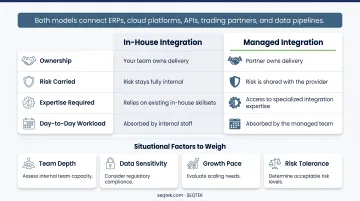
The table captures the structural tradeoffs, but the right choice depends on your organization's specific constraints — team depth, data sensitivity, growth pace, and risk tolerance. The situational factors below will sharpen that decision.
What Is In-House Integration?
In-house integration means your internal team owns the full stack — design, build, deployment, monitoring, and ongoing maintenance. That means connecting ERPs, cloud platforms, APIs, and business applications using your own people, your own tools, and your own institutional knowledge.
The Talent Reality
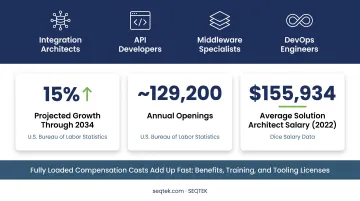
This model requires a broad range of specialized expertise: integration architects, API developers, middleware specialists, and DevOps engineers. Finding that talent is harder than it sounds. According to the U.S. Bureau of Labor Statistics, software developer employment is projected to grow 15% through 2034, with approximately 129,200 openings annually — and those are broad figures that don't capture integration-specific roles, which tend to be even harder to fill.
Solution architects averaged $155,934 in 2022 according to Dice salary data. Add benefits, training, and tooling licenses, and fully loaded compensation costs add up fast across a capable integration team.
The Control and Customization Advantage
Organizations choose in-house for clear reasons:
- Direct access to the team — no tickets, no SLA queues
- Full visibility into data flows, especially for sensitive or regulated environments
- Ability to customize workflows to match internal processes exactly
- No third-party dependency for mission-critical systems
For highly regulated sectors, this matters enormously. SEQTEK's banking engagement — where the client operated in a compliance-intensive environment requiring complete traceability across FIS, Bloomberg, Pershing, and IBM MQ — is a clear example of why internal control can be non-negotiable.
The Key Person Risk
The most underestimated risk in in-house integration is what's often called the "bus factor" — when critical integration knowledge lives in one or two people, the organization becomes fragile. A departure or a restructuring can leave ERP-to-supplier connections, API orchestrations, and data pipelines without anyone who understands how they were built.
This risk compounds as the integration landscape grows. More systems, more dependencies, more surface area for problems — and fewer people who understand all of it.
That fragility shapes when in-house integration makes sense and when it becomes a liability worth reconsidering.
When In-House Works Best
- Large, stable IT departments with dedicated integration staff
- Integrations tied to proprietary systems or highly sensitive data
- Organizations where the integration layer itself is a competitive differentiator (e.g., a technology company building products on top of its own integration infrastructure)
- Regulated industries — oil and gas enterprises managing SCADA/ERP environments, or financial institutions with strict data governance requirements — where external access to data flows is off the table
What Are Managed Integration Services?
Managed integration services transfer full or partial ownership of integration design, deployment, monitoring, incident response, and ongoing optimization to a third-party provider. The relationship is governed by defined SLAs rather than an internal staffing model.
How the Operational Model Differs
Managed providers bring pre-built expertise across protocols — REST APIs, EDI, event streaming, ESB architecture — and integration patterns that internal teams often spend months learning when a new system enters the environment. That expertise gap is what makes onboarding slower and error-prone in in-house models.
The overall managed services market reflects how broadly organizations have adopted this approach. Grand View Research values the managed services market at $401.2 billion in 2025, with a projected CAGR of 9.9% through 2033 — a scale that reflects genuine enterprise demand.
Cost Predictability and SLA Accountability
Managed services shift integration from a capital-intensive staffing model to a subscription-based operational cost. This changes how IT leaders plan budgets — moving from unpredictable CapEx (hires, tooling purchases, infrastructure) to a defined monthly or annual OpEx commitment.
On the accountability side, managed providers operate with contractual uptime commitments. MuleSoft, for example, contractually commits to 99.95% monthly uptime for covered cloud offerings, with defined service credits below that threshold. Most internal teams cannot sustain equivalent coverage without significant investment in monitoring, on-call rotations, and redundant staffing.
When Managed Services Work Best
- Mid-sized enterprises scaling rapidly and unable to hire fast enough
- Organizations replacing a retiring or departing integration expert
- Companies migrating to the cloud that need fast ramp-up on new platforms
- Businesses managing multiple trading partners or data sources requiring constant maintenance
A concrete example: when a manufacturing company's sole integration developer leaves, they often take undocumented knowledge of critical ERP-to-supplier connections with them. A managed services provider can assess the existing environment, stabilize what's running, and extend coverage — without a full rebuild.
That continuity matters across sectors. In 2023, 70% of U.S. hospitals participated in all four measured domains of interoperable health information exchange, yet EHR complexity continues to grow — making managed integration support a practical necessity, not a premium option.
Which Model Is Right for Your Organization?
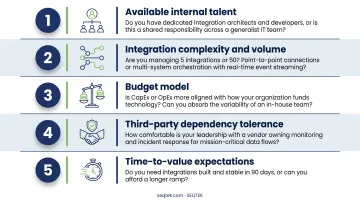
Start by answering these five questions:
- Available internal talent — Do you have dedicated integration architects and developers, or is this a shared responsibility across a generalist IT team?
- Integration complexity and volume — Are you managing 5 integrations or 50? Point-to-point connections or multi-system orchestration with real-time event streaming?
- Budget model — Is CapEx or OpEx more aligned with how your organization funds technology? Can you absorb the variability of an in-house team?
- Third-party dependency tolerance — How comfortable is your leadership with a vendor owning monitoring and incident response for mission-critical data flows?
- Time-to-value expectations — Do you need integrations built and stable in 90 days, or can you afford a longer ramp?
Choose In-House If:
- Your team includes experienced integration architects and developers
- Your integrations involve proprietary or regulated data that cannot leave your environment
- Your competitive advantage is directly tied to the integration layer you own and control
Choose Managed Services If:
- Your team lacks the depth for ongoing integration maintenance
- You're scaling quickly and can't hire specialized talent fast enough
- Integration is critical to operations but not a strategic differentiator — making reliability and SLA-backed coverage more important than ownership
The Hybrid Option: Localshoring® Delivery Model
There's a third path worth serious consideration. SEQTEK's Localshoring® Delivery Model is a co-development approach where an external partner integrates directly with your internal team — bringing specialized integration expertise while preserving alignment, transparency, and shared ownership of the work.
Unlike offshore outsourcing, the external team works embedded in your environment — operating in the same time zone, accountable to your priorities, and without the communication gaps that plague fully outsourced arrangements.
If those five questions left you somewhere in the middle, that's where most organizations land. Here's the short version:
- Control matters and you have the team → Build in-house
- Speed, scalability, and predictable costs are the priority → Go managed
- Want both with shared ownership → Co-managed Localshoring® Delivery Model bridges the gap
Real-World Application: How Organizations Navigate This Decision
The shift from in-house to a managed or co-managed model rarely happens by design. It happens in response to a trigger.
Consider a mid-sized manufacturer managing ERP connections to a growing list of suppliers. Early on, one or two developers built those integrations and maintained them. The model worked — until the organization added cloud platforms, the integration developer left, and a cloud migration exposed integrations nobody had fully documented.
At that inflection point, three options exist: hire fast (difficult in a tight market for specialized talent), rebuild from scratch (expensive and risky), or bring in a partner who can assess the existing environment, stabilize what's running, and extend coverage under a defined model.
That third option works not as a replacement for internal capability, but as a way to maintain integration reliability while your organization determines what the right long-term model looks like.
The trigger events that drive this decision are almost always one of three things:
- A team gap — a key departure that leaves integration knowledge homeless
- A failed integration — an outage or data error that exposes how underpowered the current model is
- A transformation initiative — a cloud migration or ERP replacement that reveals the gap between what the team can build and what the business needs
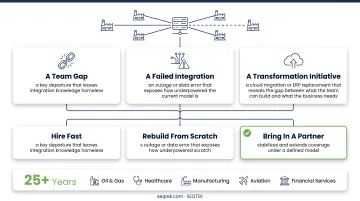
When one of these triggers hits, the next move is assessing what you have, what's at risk, and which model fits where you're headed. SEQTEK has worked through this exact scenario with organizations across oil and gas, healthcare, manufacturing, aviation, and financial services — from SCADA modernization for Fortune 100 energy companies to enterprise integration layers for regulated banking institutions — for 25+ years.
Conclusion
In-house integration and managed services are both legitimate paths. Neither is universally superior. The right choice depends on where your organization sits today — in terms of talent depth, integration complexity, and growth trajectory.
What matters most is that your integration model matches how your organization actually operates — not how you wish it did. Some organizations build strong in-house capabilities over time. Others move faster by partnering with a team that already understands the landscape. Many find the right answer somewhere between the two.
SEQTEK's Localshoring® Delivery Model is designed for exactly this kind of decision. Rather than handing off integration work to a remote team or locking clients into rigid service packages, SEQTEK works alongside your people — sharing ownership, transferring knowledge, and building the kind of integration infrastructure that your team can sustain long after the engagement ends.
Frequently Asked Questions
What is service integration management?
Service integration management (SIAM) is a framework for managing multiple service providers — internal and external — to deliver a unified IT service to the business. Defined and maintained by Scopism, SIAM introduces a service-integrator capability that handles coordination, governance, and performance accountability across all providers.
What is the difference between an MSP and a BPO?
An MSP takes ongoing operational responsibility for a specific technology function (integration, infrastructure, security). A BPO handles an entire business function end-to-end, such as HR or finance. The core difference is scope: MSPs own a technology domain; BPOs own a business process.
What are examples of managed integration services?
Common examples include cloud infrastructure management, EDI and API integration, cybersecurity monitoring, and data pipeline operations. These services keep data flowing between systems by handling monitoring, incident response, and ongoing maintenance under defined SLAs.
What are the three common types of integrations?
The three most widely used integration patterns are point-to-point (direct system-to-system connections), hub-and-spoke (a central middleware or ESB routing between multiple systems), and API-led connectivity (modular, reusable APIs organized by function: system, process, and experience layers). These are common patterns, not a formal universal standard.
How do I know if my organization needs managed integration services?
Watch for these signals:
- Your integration team is too thin to manage growing complexity
- You've experienced repeated integration failures or outages
- You're mid-cloud migration and internal capacity can't keep pace
Any of these is a sign the current model isn't scaling with your needs.
Can in-house and managed integration models work together?
Yes — co-managed or hybrid models are increasingly common. Internal teams retain ownership of strategic direction and sensitive integrations, while a managed partner handles monitoring, maintenance, and complex or high-volume buildouts. This gives organizations control where it matters most without overloading internal capacity.