Introduction
Most change initiatives don't collapse because the strategy was flawed. They collapse because the people expected to carry it out never bought in.
BCG's research on digital transformation found that 70% of efforts fall short of their objectives, even when the technology and roadmap look solid on paper.
The missing piece is almost always cultural: the unwritten rules, habits, and incentives that determine whether employees embrace new processes or quietly work around them.
Leaders often treat culture as a soft concern to address after systems go live. That order of operations is backward.
This article breaks down how culture actually shapes change outcomes and lays out a practical path for aligning the two before your next transformation stalls.
Key Takeaways
- Culture determines whether employees adopt, tolerate, or quietly resist new processes and technology
- Managing culture during major transformation is directly tied to hitting financial and performance targets
- Lasting change requires leadership modeling, employee involvement, and reinforced incentives, not communication alone
- Meaningful shifts show up around 18 months in, but full adoption takes years, not quarters
- Outside partners often spot cultural blind spots internal teams are too close to see
What Is Organizational Culture and Why It's the Foundation of Change Management
Organizational culture is the shared set of values, beliefs, and unwritten rules that shape "how things actually get done" inside a company, regardless of what the employee handbook says. It's the gap between what leadership announces and what employees do when nobody's watching.
The phrase "culture eats strategy for breakfast" gets repeated in nearly every boardroom, usually credited to Peter Drucker. He never said it. The line traces back to Ford executive Mark Fields in 2006, and it's often misused as an excuse to skip strategic planning altogether.
The real lesson is narrower: a well-built transformation plan will not survive contact with a culture that hasn't been prepared for it.
Culture is the operating environment where change management efforts either take root or collapse.
Consider the M&A context specifically. Companies that actively manage culture during merger integration are roughly **50% more likely to meet or exceed their cost and revenue synergy targets**, according to McKinsey's research on merger integration. That's a hard financial outcome, not a morale metric.
Signs Your Culture May Be Blocking Change
Culture doesn't sit still. It evolves whether leadership manages it or not, which is why waiting for a crisis to assess it is a mistake. Watch for these common triggers:
- Leadership transitions: new executives arrive with different expectations, and teams often default to old habits until told otherwise
- M&A integration: two distinct cultures colliding without a deliberate plan to reconcile them
- New technology rollouts: automation or AI tools that threaten established roles and workflows
- Market shifts: competitive pressure demanding faster decisions than the current culture supports
- Rising turnover: often the clearest signal that something underneath has already broken
If any of these sound familiar, that's the moment to assess culture, not after the initiative has already launched.
How Culture Influences Change Management Success or Failure
Culture doesn't block change directly. It shapes how employees interpret it. The same software rollout can look like an exciting upgrade to one team and a threat to job security to another, depending entirely on beliefs that already existed before the announcement.
The Four I's: Where Culture and Change Collide
A useful diagnostic is the "four I's" framework, adapted from culture cycle research:
| Level | What it covers | Where change gets stuck |
|---|---|---|
| Ideas | Shared beliefs about what's normal or necessary | "This is how we've always done it" |
| Institutions | Formal policies, incentives, structures | Performance reviews still reward old behavior |
| Interactions | Daily habits: meetings, handoffs, decisions | New processes clash with informal routines |
| Individuals | Personal mindsets, skills, identity | People lack confidence or capability to change |
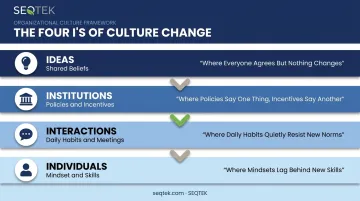
Efforts that target only one level, say announcing new policies without touching daily habits, tend to stall. All four need attention together.
When Leadership and Systems Move Together
Microsoft's turnaround under Satya Nadella illustrates the point well. The company shifted from a "know-it-all" culture defined by internal competition and risk aversion toward a "learn-it-all" mindset built on curiosity and collaboration. That shift wasn't just messaging. Microsoft eliminated stack ranking and rebuilt performance evaluation around individual impact and contribution to others' success, aligning the reward system with the behavior leadership wanted.
That pairing, visible leadership behavior plus a rebuilt incentive structure, is what most organizations skip. Stated values that don't match actual performance and reward systems remain the most common reason change initiatives stall.
MIT Sloan Management Review studied 689 large organizations and found that 82% published formal values statements, yet those statements had no meaningful correlation with how employees actually rated the culture day to day.
Leadership commitment alone doesn't fix this either. McKinsey's transformation research found that success rates were dramatically higher when frontline managers and employees were actively engaged, and success dropped close to zero when they weren't. Change has to be built top-down and bottom-up simultaneously, or it doesn't hold.
5 Steps to Successfully Change Culture During Organizational Transformation
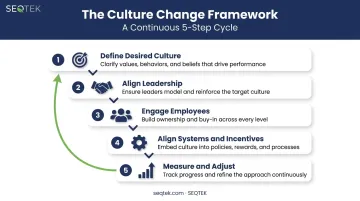
Aligning culture with a transformation takes more than a single workshop or all-hands meeting; it demands a deliberate sequence of steps. Skipping one is usually what causes the effort to unravel six months in.
- Define the desired culture and target behaviors. Start with the strategic goal, then work backward to the two or three behaviors that would move the needle most. Gather input from frontline employees here; they know where current friction actually lives.
- Align leadership around one unified vision. Executives need to agree with each other before asking anyone else to change. If leaders model old behavior while asking employees to adopt new ones, the mismatch gets noticed fast.
- Engage employees at every level. Listening sessions, feedback loops, and culture champions embedded across departments turn change from something announced into something people help build.
- Align systems and processes to reinforce new behavior. Performance management, hiring criteria, promotions, and incentives all need to reward what leadership says it wants. This is the step organizations skip most, and the one most likely to erode earlier progress.
- Measure progress and adjust. Track qualitative signals, such as employee feedback and culture surveys, alongside quantitative ones like engagement scores, adoption rates, and retention.
A note on timeline: practitioner research from Prosci suggests individual mindset shifts typically take around 18 months, while fully embedding new behavior across a larger organization can take several years depending on size and complexity. Anyone promising a fully embedded culture shift in a single fiscal year is underestimating the work involved.
Overcoming Resistance and Sustaining Culture Change
Resistance doesn't usually mean employees are difficult. It usually means they don't understand why the change matters, or they've absorbed too many failed initiatives already to trust this one.
Common obstacles include:
- Fear of the unknown — unclear implications for someone's role or job security
- Inconsistent leadership behavior — executives who say one thing and do another
- Lack of clarity — no clear picture of what success looks like or how to get there
- Change fatigue — teams that have absorbed multiple reorganizations or system rollouts with little payoff
To reduce resistance:
- Communicate transparently in both directions, not just through top-down memos
- Involve employees in shaping the change itself, not just receiving it
- Celebrate early adopters publicly to create visible proof that the change is working
Reducing resistance gets employees on board, but the work doesn't end at launch. Old incentives and habits don't disappear on their own, and left unaddressed, they pull people back to familiar patterns even after a successful rollout. That's why SEQTEK builds reinforcement checkpoints into every change management engagement: sustaining culture change means continuing to reinforce it long after go-live, not declaring victory too soon.
Partnering with Experts to Align Culture and Change Management
Internal teams are often too close to their own culture to see it clearly. An outside perspective can surface blind spots and inefficiencies that get missed simply because "that's how we've always worked here."
SEQTEK works with organizations across aviation, oil and gas, banking, healthcare, and manufacturing to connect culture work to the actual technology and process transformation underway, rather than treating them as separate workstreams. A new system or AI-driven workflow won't get adopted if the culture underneath it hasn't been prepared for it.
SEQTEK's Localshoring model supports this by embedding local, onsite teams directly alongside client staff instead of relying on offshore, asynchronous handoffs.
That proximity delivers concrete advantages:
- Cuts communication friction, including time-zone lag and lost context, that typically slows adoption
- Builds solutions around how a client's people actually work
- Increases adoption instead of fighting against it

One client, describing a period of being "overwhelmed and overstretched," put it this way:
"SEQTEK brought our people together, developed a strategy, and worked with us to implement the plan."
Another noted, "They collaborate well with our people and culture. I believe they care about our people."
The right partner doesn't replace internal capability. It adds capacity, structure, and momentum, so leaders aren't building every culture-change muscle from scratch while still running the business.
Frequently Asked Questions
What are the 5 steps in changing culture?
Define the desired culture and behaviors, align leadership around one vision, engage employees at every level, adjust systems and incentives to reinforce new behavior, and measure progress continuously.
How does culture influence change?
Culture shapes how employees interpret new processes and technology, determining whether they embrace, tolerate, or quietly resist a transformation. Without cultural alignment, even well-designed initiatives struggle to stick.
What is an example of a change in culture?
Microsoft's shift from an internally competitive "know-it-all" culture to a collaborative "learn-it-all" mindset under Satya Nadella, paired with removing stack ranking, is a well-documented case.
How long does culture change typically take?
Individual mindset shifts often take around 18 months, per Prosci's research, while fully embedding new behaviors across a larger organization can take several years depending on size and complexity.
Who is responsible for leading culture change in an organization?
Senior leaders must own and visibly model the change, but lasting transformation requires active engagement from managers and employees at every level, not just an executive mandate.
What is the difference between culture change and change management?
Change management focuses on executing specific initiatives, like new systems or structures. Culture change addresses the underlying values and behaviors that determine whether those initiatives get adopted long-term.