That gap is the whole story. Most small businesses have experimented. Few have built anything durable.
The reasons are familiar: tight budgets, no in-house data team, and genuine confusion about where AI actually fits day-to-day operations. This guide breaks down what AI consulting includes, what it realistically costs in 2026, the use cases delivering the fastest returns, and how to vet a partner before you sign anything.
Key Takeaways
- AI consulting costs range from a few thousand dollars for a readiness assessment to $50,000+ for full implementation
- Focused pilot projects reach measurable ROI far faster than company-wide AI transformations
- Local, industry-specialized consultants reduce friction compared to generalist or offshore providers
- Targeting high-volume, repetitive tasks first is the fastest path to positive ROI
Why Small Businesses Need AI Consulting in 2026
AI has become a competitive equalizer. Tasks that once required an enterprise IT budget, like automated customer service, demand forecasting, or predictive maintenance, are now accessible to a 15-person company with the right guidance.
Most small businesses start with one of three entry points:
- Chatbots and customer service automation — handling routine inquiries so staff can focus on complex issues
- Demand forecasting — using historical sales data to reduce overstock and stockouts
- Predictive maintenance — flagging equipment issues before they cause costly downtime
The barriers to getting there are consistent across industries:
- Budget constraints: most SMBs can't justify a full-time data science hire
- Lack of internal expertise: someone has to know which tools actually solve the problem
- Organizational resistance: employees worried about job security or overwhelmed by another new system
This is exactly where a consultant earns their fee. A good one handles four things:
- Identifies which processes are genuinely ripe for automation
- Selects tools that fit your existing tech stack
- Integrates them without breaking anything
- Trains your team to actually use what's been built
The payoff shows up fast when it's done right. Thryv's 2025 survey of small business decision-makers found that 58% of AI-using SMBs saved more than 20 hours per month, and 66% reported monthly savings between $500 and $2,000.
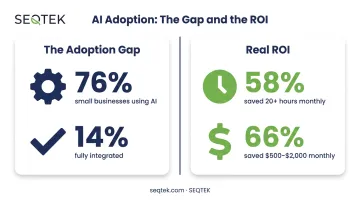
That's not enterprise-scale transformation. That's a small team getting real hours back every week.
What AI Consulting for Small Businesses Actually Includes
AI consulting unfolds across several phases rather than arriving as one deliverable. Skipping any of them is usually where implementations fail.
Discovery and Readiness Assessment
This phase evaluates your current tech infrastructure, data quality, and workflows to find where AI can make the biggest impact fastest. Most assessments run two to four weeks and produce a prioritized list of opportunities rather than a vague "AI strategy."
Strategy Development and Implementation
Once the assessment wraps, the findings translate into a roadmap covering:
- Which tools to use
- What needs to integrate with your CRM or accounting software
- Realistic timelines and budget
The best roadmaps favor quick wins over sprawling transformations — a single automated workflow that works beats five half-finished pilots.
Implementation then means:
- Configuring the selected tools
- Connecting them to systems your team already uses daily
- Building workflows employees will actually adopt, not just tolerate
Change Management and Ongoing Optimization
Even a well-configured tool stalls without user buy-in. Clear communication about why a change is happening matters as much as the technology itself. Once live, AI tools also need periodic review. Models drift, data changes, and a tool that worked well in month one can lose accuracy by month six without maintenance.
How Much Does AI Consulting Cost for Small Businesses in 2026
Pricing depends heavily on scope. A focused readiness assessment costs far less than a multi-department implementation, and most consultants structure fees around that reality.
| Service Tier | What It Includes | Typical Timeline |
|---|---|---|
| Readiness Assessment | Infrastructure and data audit, opportunity mapping | 2–4 weeks |
| Strategy & Roadmap | Tool selection, integration plan, budget | 2–6 weeks |
| Pilot Implementation | One workflow built, tested, and deployed | 4–12 weeks |
| Full-Scale Implementation | Multiple systems, departments, ongoing support | 3–6+ months |
According to AI Essentials' 2026 consultant cost breakdown, independent AI consultants typically charge $150 to $350 per hour, with project-based engagements landing between $5,000 and $25,000. Full implementations involving multiple integrations can push well past that.
A fractional AI advisor model has also become a popular middle ground. Instead of hiring a full-time AI lead (a salary most small businesses can't justify), you retain ongoing strategic guidance at a fraction of the cost. This works especially well for businesses that need continuous direction but not a full department.
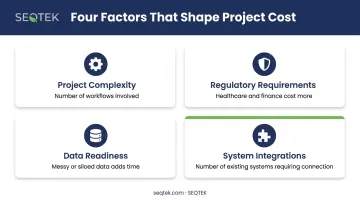
What actually drives cost:
- Project complexity and number of workflows involved
- Industry regulatory requirements (healthcare and finance cost more)
- Data readiness — messy or siloed data adds time
- Number of existing systems requiring integration
Realistic expectations matter too. Most SMB pilots see efficiency gains within weeks, especially when targeting repetitive, high-volume tasks. Break-even timing still varies by business, so treat any consultant's promised payback period with a healthy dose of scrutiny.
Ask any consultant for a full cost breakdown before signing, covering software licensing, integration work, and ongoing maintenance. Hidden fees in year two are the most common surprise SMBs report.
How to Choose the Right AI Consulting Partner
Not every consultant who says "AI" understands your business. Vetting matters more here than in almost any other consulting category, because the tools change faster than most contracts get renegotiated.
Start with clear, measurable objectives. Define SMART goals tied to specific outcomes, like "reduce invoice processing time by 30%," not vague ambitions like "become more AI-driven." A consultant can't hit a target you haven't set.
Look for industry-specific experience. Ask for case studies or references from businesses your size, in your sector. A consultant who's only worked with enterprise clients may design something too complex for your team to maintain.
Watch for these red flags:
- Guaranteed ROI promises with no caveats
- Pressure toward a single-vendor, locked-in tool ecosystem
- No discovery phase before jumping to implementation
- Push for company-wide transformation instead of a focused pilot
This is where SEQTEK's approach diverges from typical offshore or generalist models. SEQTEK operates on a Localshoring model, pairing clients with local talent instead of distant offshore teams. That eliminates time-zone friction, keeps communication direct, and speeds up feedback loops that would otherwise stall a project for days.
SEQTEK has spent 25+ years working across aviation, oil and gas, healthcare, and manufacturing, structuring engagements around outcomes rather than rigid task lists.
The philosophy is straightforward: act as a trusted partner, not a vendor. That means building capability your team keeps long after the engagement ends. For a small business wary of a generic offshore contract, that focus on lasting capability matters most.
Top AI Use Cases and ROI Timeline for Small Businesses
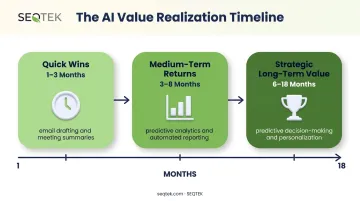
Not every AI project delivers value on the same timeline. Understanding which bucket a project falls into helps set realistic expectations before you invest.
Quick Wins (1 to 3 Months)
Automating repetitive, high-volume tasks delivers the fastest measurable time savings. Think:
- Email drafting and customer response templates
- Meeting summaries and note-taking
- Routine customer communication and follow-ups
A single automated response template can save a five-person team several hours each week almost immediately, making these quick wins the smart starting point for a first pilot.
Medium-Term Returns (3 to 8 Months)
More complex implementations take longer to calibrate but deliver bigger operational gains:
- Predictive analytics for inventory or sales
- Automated reporting across departments
- Deeper workflow integration with existing systems
Setup takes longer, and cleaning up existing data adds time upfront, but the payoff compounds once these systems run smoothly.
Strategic Long-Term Value (6 to 18 Months)
The highest-value use cases, like predictive decision-making and scaled personalization, create a lasting edge over competitors still doing things manually. They require sustained investment and real organizational commitment, but they're also what separates businesses that treat AI as a tool from those that build it into their competitive strategy.
Frequently Asked Questions
How much does AI consulting for small businesses cost?
Costs typically range from a few thousand dollars for an initial readiness assessment to $25,000 or more for a pilot implementation, depending on scope and complexity. Full-scale, multi-system projects can exceed $50,000.
What is the best AI for small business consulting?
There's no universal answer. A good consultant helps you evaluate general-purpose platforms against industry-specific tools based on your actual workflows, not a one-size-fits-all recommendation.
How long does a typical AI consulting engagement take?
Readiness assessments usually take two to four weeks. Pilot implementations run anywhere from several weeks to a few months, depending on how many systems need to connect.
Can small businesses just use ChatGPT instead of hiring a consultant?
For basic tasks like drafting emails or summarizing notes, self-directed tool use works fine. Consulting adds real value once you're integrating AI with existing systems or scaling beyond simple, one-off use cases.
What industries benefit most from AI consulting?
Industries with high volumes of documents, data analysis, or customer communication see the biggest returns, including healthcare, financial services, manufacturing, and professional services.
How do I measure whether AI consulting was successful?
Track hours saved, error reduction, and revenue impact starting before the engagement begins and continuing for several months afterward. Baseline data matters as much as the results themselves.