That's the good news. Here's the harder truth: most enterprises still struggle to get past the pilot stage. Many organizations can build an impressive demo. Far fewer can run a governed, production-grade agent that touches real systems, real data, and real compliance risk.
This guide covers what enterprise AI agents actually are, how they automate cross-system workflows, how to choose the right approach for your organization, and how a partner like SEQTEK helps enterprises move from experimentation to production without the usual missteps.
Key Takeaways
- Enterprise AI agents run multi-step workflows across systems, beyond chatbots or scripted RPA
- Data readiness, governance, and change management matter more than platform choice
- Banking, manufacturing, oil and gas, and healthcare already have documented agentic use cases
- A phased, outcome-driven rollout cuts risk and speeds time-to-value
What Are Enterprise AI Agents?
Enterprise AI agents are governed software systems that pursue a goal across multiple steps, pull from enterprise tools and data, make bounded decisions, and escalate to humans when needed. IBM draws a clean distinction here: agents specialize in complex tasks autonomously, while assistants focus on understanding and responding to user input (IBM).
Anthropic separates the two cleanly: workflows follow predefined code paths, while agents dynamically direct their own process and tool use (Anthropic, 2024).
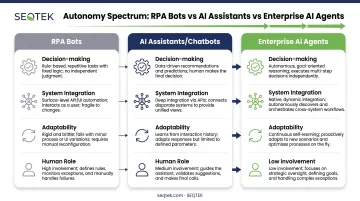
How Agents Differ from Assistants and RPA
| Capability | RPA Bots | AI Assistants/Chatbots | Enterprise AI Agents |
|---|---|---|---|
| Decision-making | Rule-based, scripted | Reactive, conversational | Autonomous, goal-driven |
| System integration | Single task, brittle | Limited | Multi-system orchestration |
| Adaptability | None — breaks on change | Some, within conversation | Learns and adjusts across steps |
| Human role | Sets rules upfront | Answers questions | Reviews exceptions, sets guardrails |
Core Capabilities
Real enterprise agents share four traits:
- Contextual awareness — pulling live data from ERP, CRM, or ITSM systems rather than static inputs
- Tool and API integration — calling functions, databases, and external services mid-task
- Multi-step reasoning — breaking a goal into sequenced actions and adjusting when conditions change
- Continuous learning — improving performance from outcomes and feedback loops
One distinction matters more than any feature list: agentic AI takes action. Generic generative AI produces content. An agent files the claim, schedules the maintenance, or flags the transaction.
How Enterprise AI Agents Power Automation
A single-purpose bot that extracts invoice data is useful. An agent that extracts the invoice, checks it against a purchase order in the ERP, validates vendor status in the CRM, and routes exceptions to a human is transformative. Real value comes from orchestrating work across systems, not automating one isolated task.
A Real Multi-Step Example
McKinsey's 2025 banking case study describes a "KYC factory" where ten agent squads handled onboarding checks end-to-end: gathering company filings, verifying government registers, mapping ownership structures, screening sanctions lists, and consolidating a final recommendation for human review. One human supervisor typically oversaw 20 or more agents, with McKinsey citing potential productivity gains of 200% to 2,000% (McKinsey, 2025). That figure is a range of potential results, not a guaranteed outcome.
Industry Applications
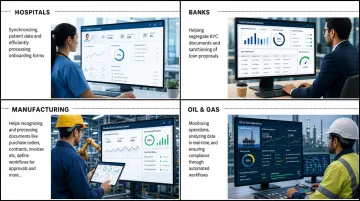
- Banking: Fraud detection and KYC/compliance automation, with agents handling document collection, verification, and risk scoring before human sign-off
- Manufacturing: Predictive maintenance agents that evaluate timing, check parts availability, schedule technicians, and shift workloads to other machines (IBM)
- Oil and gas: Supply chain agents coordinating suppliers, plants, logistics, and inventory systems with policy thresholds and human escalation points (Deloitte, 2026)
- Healthcare: Multi-agent systems matching patients to trials from EHR notes, imaging, and genomics; Microsoft reports hours of expert work reduced to minutes (still R&D-stage, not clinical-ready) (Microsoft, 2025)
Those examples only work when systems can exchange clean, governed data. SEQTEK has seen the gap firsthand. In one banking engagement, a stalled two-year integration effort was blocked by disconnected systems across FIS, Bloomberg, Filenet, and internal applications. The client's own words: "We don't know who's talking to whom—there's no visibility, no orchestration, and no confidence in the data flow." SEQTEK rebuilt the integration layer with microservices and messaging governance before automation could run reliably on top of it.
That's the pattern enterprises miss. The AI model is rarely the bottleneck; data readiness and workflow integration are. If your systems can't reliably talk to each other, no agent, however sophisticated, will produce trustworthy output.
Which Enterprise AI Agent Approach Is Best for Your Organization?
There's no universal winner here. The right approach depends on your existing tech stack, industry regulatory demands, and internal engineering capacity.
Evaluation Criteria That Actually Matter
Before scaling any agent deployment, test against these criteria:
- Governance and auditability — Can you prove why the agent made a decision?
- Integration depth — Does it connect cleanly to your ERP, CRM, and ITSM systems?
- Scalability — Will it hold up moving from one workflow to twenty?
- Compliance — Does it meet your industry's regulatory bar (SOX, HIPAA, KYC)?
- Deployment speed — How long from pilot to production?
- Pricing transparency — Are costs predictable as usage scales?
Build vs. Buy
Those criteria usually point you toward one of two paths:
- Platform-native agents (embedded in your ERP or CRM): faster to deploy and integrate natively, with less flexibility for unique workflows
- Custom multi-agent orchestration: longer to build, but adapts to complex, ambiguous processes packaged tools can't handle
SEQTEK's technology-strategy work weighs this decision against five factors: speed, cost, scalability, competitive advantage, and long-term flexibility. A rule-based agent handling repetitive compliance checks rarely needs custom orchestration. A cognitive agent making judgment calls on ambiguous claims data usually does.
Common Risks and Implementation Pitfalls
Agentic automation introduces new failure modes that traditional software never had to manage.
Governance and Accountability Gaps
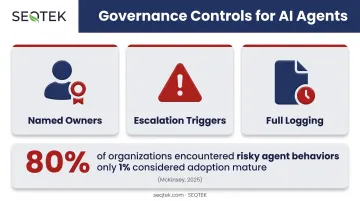
McKinsey frames autonomous agents as potential "digital insiders" with real system privileges. Its research found 80% of organizations encountered risky agent behaviors, including improper data exposure and unauthorized system access, while only 1% considered their AI adoption mature (McKinsey, 2025). Without basic controls, nobody can explain what an agent did or why:
- Named owners for each agent and workflow
- Clear escalation triggers when behavior drifts
- Full logging of actions, inputs, and decisions
Integration Complexity
Starting with a broad, ambitious use case is a common mistake. Enterprises with disconnected legacy systems, unreliable batch jobs, and no visibility into data flow usually scale failure instead of automation. Narrow, high-value pilots expose integration gaps before they become production incidents.
Change Management Failure
Deloitte's 2026 survey of 3,235 leaders across 24 countries found only one in five companies had a mature governance model for autonomous agents. Insufficient worker skills was the top barrier to integration (Deloitte, 2026). SEQTEK's engagement history backs this up: 70% of transformation initiatives fail, and the people side of change is consistently the leading cause, not the technology.
How SEQTEK Helps Enterprises Move From AI Pilots to Production
Moving AI agents from pilot to production takes more than a strong demo. SEQTEK has operated as a strategic consulting and technology partner since 1999, working across aviation, oil and gas, banking, healthcare, and manufacturing. Its client roster includes GE, ABB, ONEOK, and Vetsource—enterprises that needed disciplined technology transformation with clear accountability.
The approach centers on three things enterprises consistently underinvest in:
- Clarifying strategy before technology decisions get made, so priorities and goals are defined up front
- Evaluating architecture, platforms, tools, and AI opportunities to match the right agent approach to the actual business problem
- Providing specialized talent (architects, engineers, analysts) to fill capability gaps without long-term dependency
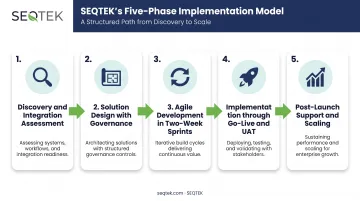
SEQTEK moves clients through a five-phase process:
- Discovery and integration assessment
- Solution design with governance built in
- Agile development with two-week sprint cycles
- Implementation through go-live and UAT
- Post-launch support that scales the solution across the organization
Why Localshoring® Matters for AI Rollouts
Distant outsourced teams create delay and misalignment exactly when you need fast iteration. SEQTEK's Localshoring® Delivery Model uses dedicated, integrated teams working in alignment with your organization, cutting the communication lag and cultural friction that stall offshore engagements. You get faster feedback cycles, clearer governance, and stronger adoption, because the people building your agent workflows understand how your teams actually work.
Frequently Asked Questions
What are enterprise AI agents?
Enterprise AI agents are autonomous software systems that reason, plan, and act across integrated business systems, with governance and human escalation built in. They differ from chatbots by taking action, not just generating responses.
How are AI agents used for enterprise automation?
They orchestrate cross-system workflows like procurement, claims processing, and compliance checks, pulling data from ERP, CRM, and ITSM systems, then routing exceptions to humans. A single agent workflow might touch five or more systems in sequence.
Which AI agent is best for enterprise use?
There's no single best platform. The right choice depends on your existing tech stack, industry regulatory needs, and internal engineering capacity, not a universal ranking.
How do AI agents differ from RPA bots?
RPA bots follow fixed, scripted rules and break when processes change. AI agents reason through ambiguous situations, adapt to new conditions, and make bounded decisions within governance limits.
What is the biggest challenge in deploying enterprise AI agents?
Data readiness and integration complexity, not the AI model itself. Disconnected legacy systems and unclear data flow cause far more failures than model performance.
How long does it take to see ROI from AI agent implementation?
Pilots can show early value within weeks, but enterprise-wide rollouts typically take 6 to 18 months depending on integration complexity and governance maturity. There's no universal timeline; each organization's baseline systems dictate the pace.