That finding matters because most companies still treat digital transformation like a software rollout: pick a vendor, migrate the data, flip the switch, done. That's not what it is anymore.
Digital transformation today is a continuous shift in how people work, not a project with a finish line. New tools arrive quarterly. Processes get rebuilt around AI and automation. Employees are asked to learn new systems while still hitting quarterly targets.
This guide breaks down what change management actually means in a digital transformation context, the frameworks leaders use to structure it, and proven strategies, plus how to choose the right partner, to make adoption stick.
Key Takeaways
- Digital transformation change management runs continuously, not just until go-live
- Traditional change models assume a stable end state digital transformation never reaches
- Adoption depends on two-way dialogue and leadership at every level, not top-down mandates
- The 5 Pillars and 5 C's give leaders a shared framework for their approach
- An experienced partner with embedded, local teams shortens adoption and cuts execution risk
What Is Change Management in Digital Transformation?
Digital transformation change management is the discipline of guiding people, culture, and processes toward adopting new technologies and new ways of working. It's the human infrastructure underneath every system migration, automation rollout, or AI initiative.
That definition matters because it differs from traditional IT change management in a specific way:
| Aspect | Standalone IT Projects | Digital Transformation |
|---|---|---|
| Scope | One system, one go-live date, one training cycle | Multiple overlapping tools, workflows, and mindset shifts |
| Timeline | Fixed start and end | Ongoing, with no fixed endpoint |
Unlike a single implementation event, digital transformation change management has to address a moving target. Tools keep changing, workflows keep evolving, and mindsets have to keep pace. Treating it as a one-time initiative is where most programs stall.
Why Traditional Change Management Models Fall Short
Most classic change models are built around a simple idea: move from Point A (current state) to Point B (future state), then stabilize. That works for a single system upgrade. It falls apart in digital transformation, where there's no fixed future state to arrive at.
Call it the "no tunnel, no light" problem. There's no end-of-tunnel stability to promise employees, because the next wave of technology change is already queued up behind this one. Change management has to build ongoing adaptability instead of promising a return to normal.
There's also an uncomfortable truth leaders often skip: not everyone wins in a transformation. Roles shift, and some skills become less valuable. Only 32% of leaders globally say they successfully get employees to adopt change in a healthy way, according to Gartner's 2025 research on workplace change.
Gartner's conclusion is direct: organizations that build repeatable change capabilities outperform those relying on inspirational leadership speeches alone. Being upfront about what's changing, including the hard parts, builds more trust than a highlight reel of benefits.
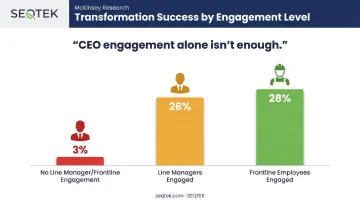
C-suite buy-in isn't enough on its own, either. McKinsey's research on successful transformations found stark gaps in success rates based on who gets engaged:
| Engagement Level | Transformation Success Rate |
|---|---|
| No line manager or frontline engagement | 3% |
| Line managers engaged | 26% |
| Frontline employees engaged | 28% |
Nearly every transformation in that study had an engaged CEO, yet that alone didn't move the needle. Middle managers translate strategy into daily habits; skip them, and the strategy stays on a slide deck.
The 5 Pillars of Digital Transformation
Digital transformation efforts tend to cluster around five interconnected areas. Consulting research from McKinsey, MIT Sloan, and Deloitte frames these slightly differently, but the throughline is consistent: technology change and people change move together, or the effort stalls.
| Pillar | What It Covers | Change Management Responsibility |
|---|---|---|
| Customer Experience | Digital touchpoints, self-service, personalization | Align internal processes so teams can deliver on the new experience promise |
| Operational Agility | Faster decision cycles, automated workflows | Redesign roles and approval chains so speed doesn't outpace governance |
| Culture & Leadership | Mindset shift toward experimentation and data | Model new behaviors visibly, starting with senior leaders |
| Workforce Enablement | Skills, tools, and confidence to work differently | Build reskilling and training programs tied to real workflows |
| Technology & Data Integration | Connected systems, clean data, unified platforms | Manage the workflow disruption that comes with system consolidation |
Change management functions as the connective tissue running through all five pillars, not a standalone sixth one. A new CRM (Technology & Data Integration) is worthless if the sales team never adopts it (Workforce Enablement), and no one adopts anything if leadership hasn't modeled the shift first (Culture & Leadership).
The 5 C's of Change Management
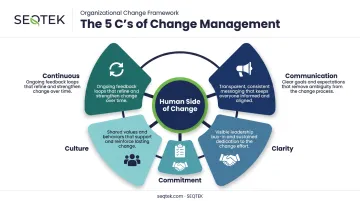
While the five pillars define what to transform, the five C's frame how to manage the human side of that change. It's a practical shorthand many change leaders use to structure their approach, not a single-vendor framework. Here's how each one plays out:
- Communication: Consistent messaging delivered through multiple channels, reinforced over weeks rather than announced once
- Clarity: Clearly defined roles, workflows, and expectations for after the change, not just before it
- Commitment: Visible follow-through from leadership at every level, beyond a single kickoff speech
- Culture: A workplace where new tools become normal practice rather than a temporary disruption
- Continuous Improvement: Regular feedback loops that adjust the approach as the transformation evolves
In practice, these principles show up in concrete ways:
- Clarity means a manager tells their team exactly what their job looks like post-implementation, not a vague promise that "things will get better"
- Continuous Improvement means a quarterly pulse survey that actually reshapes the rollout plan
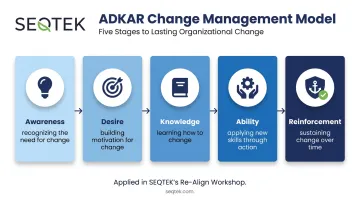
Some organizations prefer named, sequential models like Prosci's ADKAR (Awareness, Desire, Knowledge, Ability, Reinforcement) for a more structured approach. Either way, the goal is the same: pair the pillars you're transforming with a disciplined process for managing how people experience that change.
Proven Strategies to Manage Change During Digital Transformation
Frameworks set the direction. Here's how to put them into practice, six strategies that translate change management theory into daily habits leaders can operationalize now.
Foster Two-Way, Personalized Communication
Change communication that only flows downward gets tuned out fast. Employees don't need another company-wide email restating the vision. They need to know what's changing in their specific role and why.
- Replace broadcast announcements with department-level conversations
- Create open channels for questions and pushback, then actually respond to them
- Repeat key messages through multiple channels rather than a single memo
- Close the loop by sharing how employee feedback shaped the final rollout plan
Most employees would rather hear how a change affects their day-to-day work from their direct manager than from a generic company-wide memo. That preference should shape who delivers the message, not just what it says.
Empower Middle Management as Change Champions
Frontline managers sit closer to the work than any executive sponsor. Recall the earlier finding: transformations succeed just 3% of the time without engaged managers, versus 26 to 28% when managers and frontline staff are engaged.
- Equip managers with talking points before employees hear the news secondhand
- Train managers to coach through resistance, not just relay instructions
- Give managers a direct feedback loop back to the transformation team
Skipping this step means your strategy stops at the director level and never reaches the floor.
Build a Culture of Continuous Learning and Experimentation
Digital fluency doesn't happen through a single training day. It builds through repeated, low-stakes exposure to new tools.
- Run recurring upskilling programs tied to actual workflows, not generic tech-literacy courses
- Host hackathons or sandbox challenges where employees test new tools without production risk
- Treat early failures as data, not performance issues
Pairing formal training with hands-on use of new tools tends to drive faster performance gains than classroom-only training. Skills programs work best when tied to real work, not abstract modules.
Establish a Dedicated Change Function or Center of Excellence
One-off training sessions fade. Sustained transformation needs a team whose job is change management, not a side project bolted onto someone's existing role.
- Assign dedicated change practitioners who own adoption, not just IT delivery
- Build repeatable playbooks so each new initiative doesn't start from zero
- Bring in outside capacity if internal teams are already stretched thin
This is where firms offering embedded change management support, like SEQTEK, can help. Rather than adding a new internal hire, organizations can bring in practitioners who already know how to run an ADKAR-based rollout. Internal staff then stay focused on their day jobs while the change function builds momentum.

Align Incentives with New Behaviors
If performance reviews still reward the old way of working, employees will default back to it, no matter how good the new system is.
- Update KPIs to reflect the new workflow, not the legacy one
- Recognize early adopters publicly, not just top performers
- Build accountability checkpoints into existing performance cycles
Incentives don't have to be dramatic. Sometimes it's a manager calling out the team that adopted the new reporting tool fastest, in the same meeting where quarterly numbers get reviewed.
Measure Adoption with Data-Driven Metrics
"How's the rollout going?" isn't a metric. Change leaders need specific numbers tied to specific behaviors:
- Speed of adoption – how quickly employees start using the new process after launch
- Utilization rate – what percentage of the target group is actually using it
- Proficiency – how well people use it once they've started
- Training completion and feedback surveys – leading indicators before performance data catches up
- Sustainment – whether usage holds steady three, six, and twelve months after go-live
Track these by role and by process, not as a single company-wide average. A 90% adoption rate in one department can hide a stalled rollout in another.
Choosing the Right Change Management Partner for Digital Transformation
Large-scale transformation is easier to see clearly from the outside. An external partner without a stake in existing turf battles can spot blind spots internal teams miss, whether that's a workflow nobody wants to admit is broken or a department quietly resisting the new system.
SEQTEK brings that same outside vantage point, having worked as a strategic consulting and technology partner since 1999 with 25+ years of combined team experience across oil & gas, energy, banking, healthcare, and airline industries.
Its Localshoring model embeds local talent directly with client teams, cutting out the time-zone lag and communication gaps that come with offshore delivery.
That matters for change management specifically. Change work depends on trust and real-time feedback, and both erode when a transformation partner is only available for a couple of overlapping hours a day.
SEQTEK's Re-Align Workshop applies the ADKAR framework, Awareness, Desire, Knowledge, Ability, Reinforcement, to guide organizations from the first conversation about a change through full adoption, not just the kickoff.
What to look for in a change management partner:
- Cultural fit: Does the team understand how your organization actually makes decisions, not just how it's supposed to on paper?
- End-to-end capability: Can they support strategy, training, and adoption, or do they hand off after the workshop ends?
- People-first approach: Do they treat change management as central to the engagement, or as an afterthought bolted onto a technical project?
A partner who checks all three tends to reduce the two biggest transformation risks: slow adoption and a quiet reversion to old habits once the project team leaves.
If you're mapping out a transformation roadmap, SEQTEK's team can walk through what an embedded change management engagement would look like for your organization.
Frequently Asked Questions
What is digital transformation and change management?
Digital transformation is the ongoing shift toward new technologies, workflows, and data-driven decision-making. Change management is the discipline that helps people actually adopt those shifts. Together, they determine whether new technology gets used or just gets purchased.
What are the 5 pillars of digital transformation?
Most frameworks converge on five areas: Customer Experience, Operational Agility, Culture & Leadership, Workforce Enablement, and Technology & Data Integration. They're interdependent: progress on one pillar without the others tends to stall out fast.
What are the 5 C's of change management?
Communication, Clarity, Commitment, Culture, and Continuous Improvement. These five elements describe how organizations manage the human side of change, complementing structured models like ADKAR.
How long does change management take during a digital transformation?
Timelines vary by scope: a single-system rollout might take months, while an organization-wide shift can run for years. Because digital transformation itself is continuous, change management doesn't really have an end date either.
What causes change management to fail in digital transformation initiatives?
The most common causes are inconsistent communication, disengaged middle managers, and incentive systems that still reward old behaviors. Technology issues are rarely the real culprit; the people side usually is.
How do you measure the success of change management in digital transformation?
Track adoption speed, utilization rates, and proficiency by role, along with training completion and employee feedback. Sustained usage months after launch matters more than day-one enthusiasm.