Introduction
Walk into two teams inside the same company and you'll often find two different cultures. Same handbook, same values statement on the wall, completely different ways of getting work done.
That's because culture isn't handed down through a policy document. It's built day by day, through the decisions, behaviors, and communication patterns of the people leading the team.
Prosci's research on change initiatives backs this up. Projects with an extremely effective executive sponsor hit a 79% probability of meeting their objectives. With an ineffective sponsor, that number drops to 27%.
Leadership involvement isn't a nice-to-have. It's the difference between a culture shift that sticks and one that fizzles out within months.
Yet many organizations still treat culture as HR's job — something for the annual survey, not the daily standup. That's a mistake.
This article unpacks the real relationship between leadership and culture: the leadership styles that shape it, a practical 5 C's framework, and what leaders can actually do about it.
Key Takeaways
- Employees mirror what leaders model daily, not what policies say.
- Managers can account for up to 70% of the variance in team engagement scores.
- No leadership style wins every time; situational flexibility beats a rigid default.
- A quick culture audit: Clarity, Consistency, Communication, Commitment, Courage.
- Culture is most fragile during transformation, when leadership alignment matters most.
What Is the Relationship Between Leadership and Organizational Culture?
Organizational culture is the shared set of values, beliefs, norms, and behaviors that determine how work actually gets done, not how the employee handbook says it should get done.
It can't be mandated by policy alone, because employees don't experience the company through a document. They experience it through their manager.
Leaders are effectively the first line of culture. Most employees will never sit in a room with the CEO, but they interact with their direct leader every day. That relationship, more than any corporate messaging campaign, teaches people what's actually valued around here.
Leaders shape culture through three specific mechanisms:
- **How they align teams to mission and purpose**: do people understand why their work matters, or are they just executing tasks?
- How they respond to crisis and setbacks: calm and constructive, or reactive and blame-driven?
- How they treat mistakes, whether as learning opportunities or as things to be punished and hidden.
These behaviors create a feedback loop. Leadership behavior sets the norm, employees adapt their own behavior to match it, and repeated behavior hardens into culture over time. It's slow, but it's relentless.
The data supports how much weight sits on this relationship. Gallup estimates that managers account for at least 70% of the variance in engagement scores across business units. That's a significant number, one that makes the manager the primary lever on engagement.
This is also why the old business aphorism, often attributed to Peter Drucker, that "culture eats strategy for breakfast" still gets quoted in boardrooms. Whether or not Drucker actually said it, the point holds.
A brilliant strategy executed by a culture that doesn't trust its leaders, or doesn't believe in the mission, will underperform every time. Leadership's job is making sure culture reinforces strategy instead of undermining it.
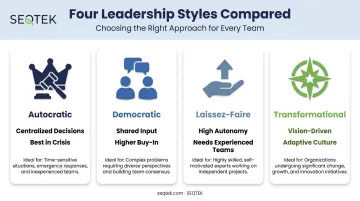
4 Types of Leadership Styles That Shape Culture
Leadership style is one of the most direct levers a leader has over day-to-day culture. Most leaders default to a single dominant style, often without realizing it. That default shapes everything from decision speed to how safe employees feel raising concerns.
Autocratic (Directive) Leadership
Decision-making stays centralized with the leader. This works well in crisis situations, safety-critical environments, or heavily regulated industries like aviation and energy, where speed and clear accountability matter more than consensus. Overused in stable, creative environments, it stifles innovation and trains employees to stop offering ideas.
Democratic (Participative) Leadership
Decisions are shared, with input gathered from the team before a direction is set. This style consistently links to higher buy-in, stronger trust, and cultures that generate more innovative ideas. People who help shape a decision are more invested in its success. The tradeoff is speed; consultation takes longer than a directive from the top.
Laissez-Faire (Delegative) Leadership
Leaders step back and give teams significant autonomy over how work gets done. It thrives with experienced, high-trust teams who already know the goals and don't need close supervision. Applied to newer or less mature teams, it often produces ambiguity, misaligned priorities, and a culture that drifts without direction.
Transformational Leadership
This style centers on vision, purpose, and inspiring people toward outcomes beyond what they thought possible. It's the style most correlated with adaptive, resilient cultures, particularly during periods of major change, such as mergers, digital transformation, or market disruption. Transformational leaders don't replace structure or accountability; they give people a reason to commit to it.
Most effective leaders blend these styles depending on the situation: directive control during a crisis, participative input when building buy-in, and delegative trust once a team has proven it can execute independently.
How Effective Leaders Build and Sustain a Strong Culture
Strong culture doesn't come from one big initiative. It's built through habits that compound over months and years.
- Connect daily work to purpose. McKinsey found employees are five times more likely to be excited about their work at organizations that actively reflect on their broader impact.
- Model values instead of posting them. Employees trust what leaders do far more than what they say; a leader who preaches collaboration while hoarding decisions undermines the message every time.
- Recognize behavior continuously, not just results. Gallup research links consistent recognition to far lower turnover, especially when it's tied to specific behaviors you want reinforced.
- Protect psychological safety. Treat mistakes as learning opportunities, not blame. Google's Project Aristotle research found this the single biggest factor separating high-performing teams from the rest.
- Check the pulse regularly. Engagement surveys and cultural audits catch small cracks before they become structural.
Protecting Culture During Transformation
Culture is most fragile during restructuring, M&A, or new technology rollouts — exactly when leaders are most distracted by logistics. This is where structured change management earns its keep.
SEQTEK pairs leadership alignment work with hands-on change management during these transitions, using an ADKAR-based framework (Awareness, Desire, Knowledge, Ability, Reinforcement) alongside leadership alignment workshops. Beyond getting a new system adopted, the aim is ensuring the people running it still trust each other once the dust settles.
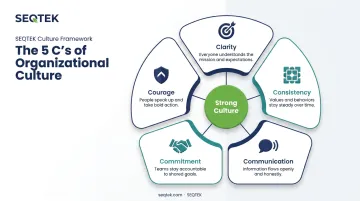
The 5 C's of a Strong Organizational Culture
The 5 C's is a practical synthesis leaders and HR teams can use to audit whether their culture is actually positioned to succeed, rather than just assumed to be healthy.
Clarity
Defined values, roles, and expectations reduce ambiguity. When people know what's expected of them and how decisions get made, they move faster because they're not guessing.
Consistency
Values applied the same way across every level and department build trust, even when it's inconvenient. Employees notice immediately when a rule bends for leadership but not for the front line.
Communication
Transparent, two-way communication is what separates strong cultures from stagnant ones. Leaders need real channels for feedback to flow upward, not just information flowing down.
Commitment
Mature culture shows mutual accountability. Leaders commit to their people the same way employees are expected to commit to organizational goals, creating a two-way relationship rather than a top-down mandate.
Courage
Strong cultures require leaders willing to have hard conversations, challenge outdated norms, and take calculated risks. Without courage, the other four C's tend to erode the first time things get uncomfortable. SEQTEK's leadership development engagements use this framework to pinpoint exactly where culture is breaking down before it affects performance.
Common Culture Challenges Leaders Must Overcome
Even well-intentioned leaders run into predictable culture problems. Naming them early makes them easier to fix.
The say-do gap. This happens when leadership behavior contradicts stated values, such as praising collaboration while rewarding lone-wolf performance. Researchers call this behavioral integrity, and it directly predicts employee trust and performance. When words and actions don't match, employees stop believing either one.
Breakdowns during major change. Culture rarely fails during quiet periods. It fails during digital transformation, restructuring, or M&A. These are the moments when leadership alignment matters most and is hardest to maintain. McKinsey research consistently links cultural fit to M&A success, identifying poor cultural cohesion as a leading cause of failed integrations.
Fragmented sub-cultures. Distributed teams, hybrid work, and multiple locations create room for departments to develop their own norms, sometimes at odds with each other. This makes consistent leadership practices across the organization essential: a remote team shouldn't experience a fundamentally different culture than headquarters.
Aligning Leadership and Culture for Lasting Business Results
The business case for alignment isn't abstract. McKinsey's organizational health research shows that companies in the top quartile of health measures (alignment, adaptability, execution, and renewal) produced roughly three times the long-term shareholder returns of bottom-quartile companies. Culture alignment directly drives those results, not a soft metric running alongside them.
The hard part is self-diagnosis. Leaders inside an organization are often too close to their own blind spots to see them clearly. The same instincts that got them promoted can make it difficult to notice when a team has quietly stopped trusting them.
This is where an outside, unbiased perspective helps. SEQTEK works as a strategic consulting and technology partner, helping organizations align leadership, strategy, and culture during growth or transformation. Its Localshoring model embeds locally based teams directly within client organizations, aiming for stronger cultural fit and faster adoption than a remote or offshore team typically achieves.
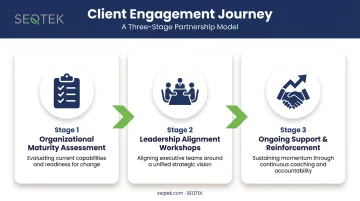
That approach reflects a broader philosophy: acting as a trusted partner rather than a vendor, and focused on outcomes that last, not just finished projects. Typical engagements follow three stages:
- A free organizational maturity assessment that establishes a baseline
- Leadership alignment workshops that surface blind spots and build shared direction
- Ongoing support after the formal engagement wraps up, so changes stick
That structure exists precisely because self-diagnosis is hard, even for good leaders.
If you're a leader wondering whether your own behavior is reinforcing the culture you want, or quietly undermining it, that's worth an honest look. Consider getting perspective from someone outside the org chart who can name what you can't see.
Frequently Asked Questions
What is the relationship between leadership and culture?
Leaders directly shape culture through their daily behavior, decisions, and communication patterns. That makes them the primary driver of whether culture strengthens or weakens over time, far more than any written policy or handbook.
What are the 4 types of leadership styles?
Autocratic, democratic, laissez-faire, and transformational. Most effective leaders blend these depending on the situation rather than defaulting to just one.
What are the 5 C's of culture?
Clarity, Consistency, Communication, Commitment, and Courage make up a practical framework for assessing whether an organization's culture is set up to succeed.
Can company culture change without changing leadership?
Sustainable culture change is extremely difficult without leadership buy-in and visible behavior change, since employees mirror what their leaders actually model far more than what gets announced.
How long does it take to shift an organization's culture?
Meaningful shifts typically take months to years, depending on organization size. It requires sustained leadership commitment, built over time rather than delivered through a single initiative or announcement.
Who is primarily responsible for shaping culture: HR or leadership?
HR designs the programs and policies, but day-to-day leadership behavior is what actually determines whether culture takes root or fades. The two need to work together, though leadership carries more weight.